Videos
No videos (yet…)
Performances

Recordings
No recordings (yet…)
No videos (yet…)
No recordings (yet…)
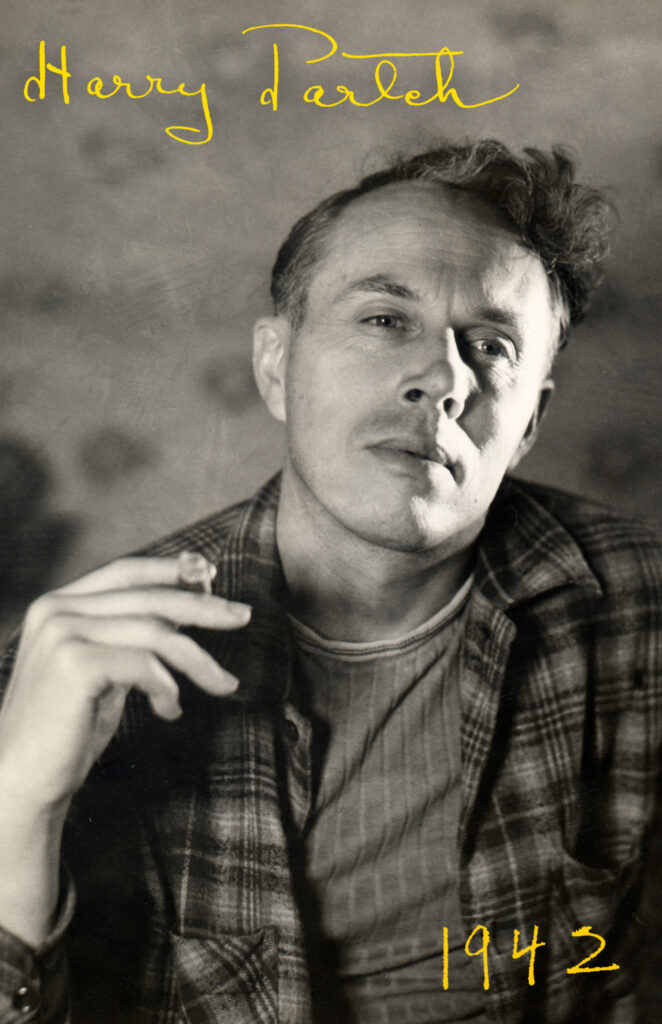
Music by Harry Partch (1901-1974)
Final two paragraph’s of Thomas Wolfe’s “God’s Lonely Man.”
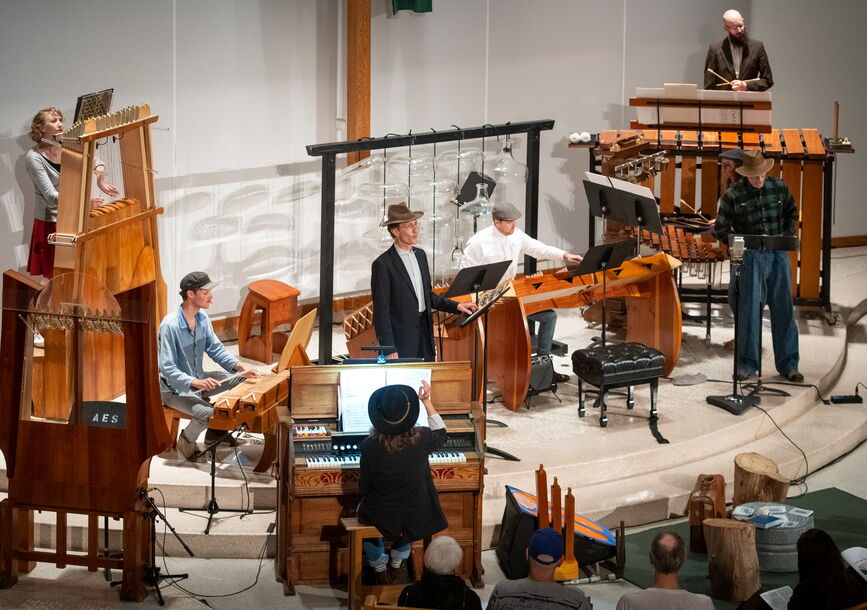
Performers:
Alison Bjorkedal – Kithara I
Vicki Ray – Chromolodeon
Derek Stein – Adapted Viola
T.J. Troy – Bass Marimba and Voice
Video captured and edited by Video Angel Productions
Audio recorded by Chris Votek
Presented by Jacaranda Music Series, First Presbyterian Church, Santa Monica, CA, November 9, 2019.
No recordings (yet…)
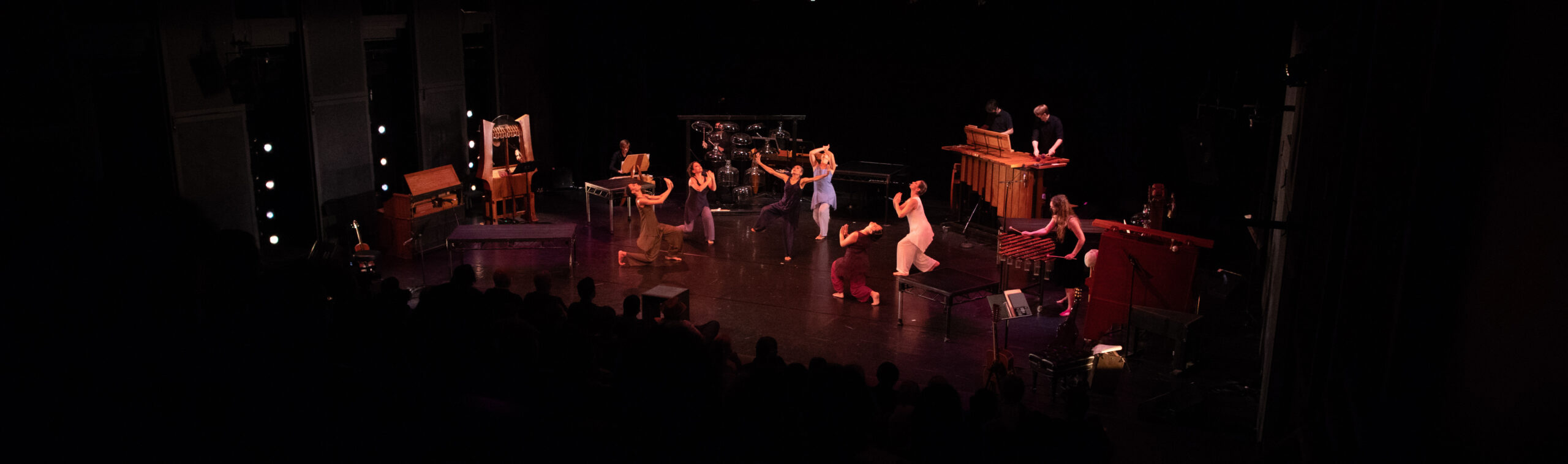
Performed by PARTCH Ensemble at REDCAT, June 2024
Progressions
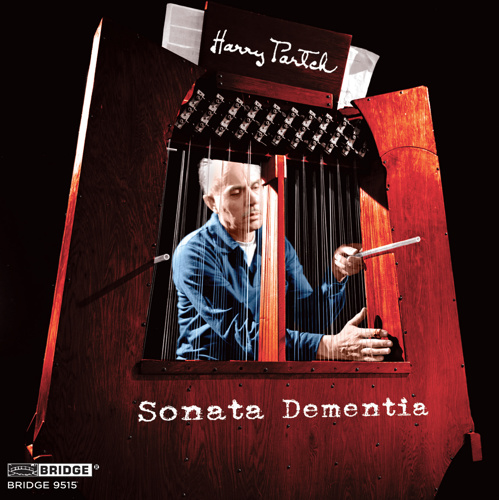
In 1942, Harry Partch gave a lecture-demonstration at the Eastman School of Music in Rochester, N.Y. After introducing the now famous 43-note/octave scale on his newly created Chromolodian (sic), he proceeded to submerse the students in an extraordinary ear-bending sequence of chord Progressions Within One Octave that even today are capable of jarring the most seasoned Modernist sensibilities. Apologizing in advance that these auditory experiments, “…afford a little vision into a new world of musical resources—hardly more than a glimpse through a keyhole,” they turned out to be a peek into the future, as this music would soon become the opening of his Sonata Dementia (1949), exquisitely orchestrated with the addition of six newly built instruments. This performance was made possible in part by a grant from the City of Los Angeles Department of Cultural Affairs.
This performance was also made possible in part by the Los Angeles County Board of Supervisors through the Department of Arts and Culture.
No recordings (yet…)
2019 Sequenza21: Best Recordings of 2019
2019 WQXR: Best Classical Recordings
2019 All About Jazz: Best Releases
2019 The Art Music Lounge Award
Percussive Notes Hall of Fame 2019
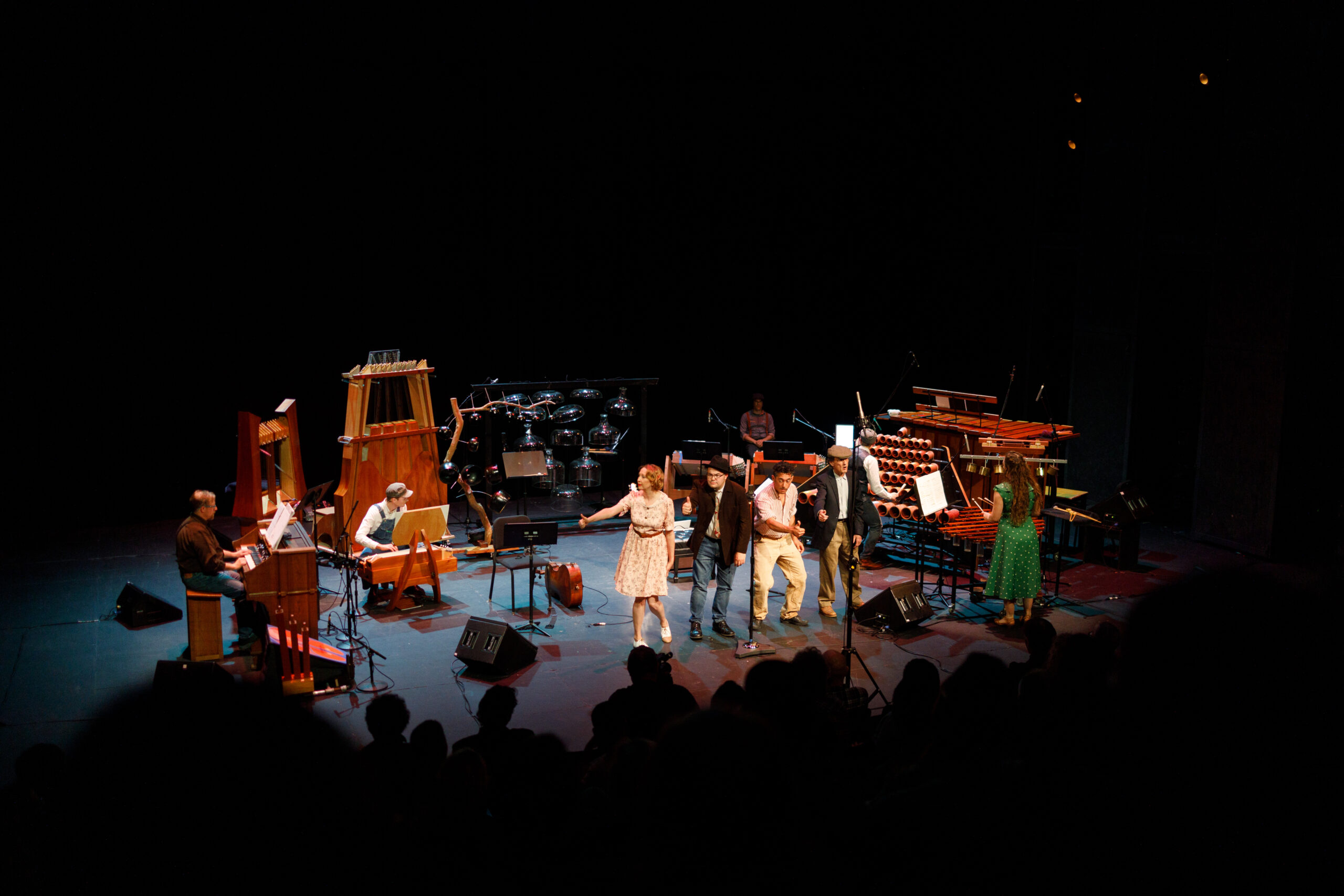
PARTCH Ensemble performing Harry Partch’s San Francisco—A setting of the cries of Two Newsboys on a Foggy Night in the Twenties at REDCAT on June 16-17, 2023.
“A collection of musical compositions based on the spoken and written words of hobos and other characters—the result of my wanderings in the Western part of the United States from 1935 to 1941.”
~ Harry Partch on The Wayward
Setting the gliding contours of real human voices had partly inspired Partch’s famed microtonal scale, and the opening viola lines of San Francisco do, in fact, wordlessly depict the curbside sales pitch with uncanny accuracy. So accurate, in fact, that when reviewing the 1944 Carnegie Hall premiere for the New York Tribune, Lou Harrison wrote, “Mr. Partch has woven a spell of about the foggiest and dampest music I have ever heard. I got homesick”.
Performed by PARTCH Ensemble at REDCAT, June 2024
Those instruments were also explored in Partch’s chimerically titled suite of twelve compositions called Intrusions. This subset of five include his Two Studies on Ancient Greek Scales that were originally for solo Harmonic Canon, to which he later added a bass marimba obligatto. Another Canon was strung and bridged in his 43-note octave from C#3-C#4 for The Wind whose hyperchromatic arpeggios hauntingly evoke two moods of that natural phenomenon that can both caress or destroy. The first text comes from the pen of Irish born poet Ella Young who lived in the Bay Area for many years, with the second from 6th century Chinese poet/philosoper Lao Tze that Partch had previously set in his 1935 memoir Bitter Music. In The Street, the chilly wind that blows over the jails and cartracks of Chicago sets the final paragraphs of Willard Motley’s 1947 best seller Knock on Any Door that describes a young Italian immigrant’s downward spiral from altar boy to criminal. And finally, Ella Young—also a Celtic mythologist who believed in fairies, pixies, and praised the benefits of talking to trees— returns to interrogate The Waterfall, curious as to why it would possibly seek oblivion after such a vivacious life in the sunlight.
— JS
This performance was made possible in part by a grant from the City of Los Angeles Department of Cultural Affairs.
This performance was also made possible in part by the Los Angeles County Board of Supervisors through the Department of Arts and Culture.
Performed by PARTCH Ensemble at REDCAT, June 2024
Progressions
In 1942, Harry Partch gave a lecture-demonstration at the Eastman School of Music in Rochester, N.Y. After introducing the now famous 43-note/octave scale on his newly created Chromolodian (sic), he proceeded to submerse the students in an extraordinary ear-bending sequence of chord Progressions Within One Octave that even today are capable of jarring the most seasoned Modernist sensibilities. Apologizing in advance that these auditory experiments, “…afford a little vision into a new world of musical resources—hardly more than a glimpse through a keyhole,” they turned out to be a peek into the future, as this music would soon become the opening of his Sonata Dementia (1949), exquisitely orchestrated with the addition of six newly built instruments. This performance was made possible in part by a grant from the City of Los Angeles Department of Cultural Affairs.
This performance was also made possible in part by the Los Angeles County Board of Supervisors through the Department of Arts and Culture.
Voices ~ Boo ~ Chromelodeon ~ Diamond Marimba ~ Surrogate Kithara
Program note by John Schneider:
The legendary 1969 Columbia recording of Barstow imprinted the work in the imaginations of a generation, and like US Highball that followed, it underwent numerous orchestrations. Hitchhiker graffiti is put to music, telling the tale of eight wanderers – some funny, some sad, but always engaging when seen through the lens of Partch’s re-telling. He gives us an earthy and poignant first-hand account that is unique in the world of music, one that is sure to become a permanent part of our American cultural landscape. Taken along with the rest of his Americana from the 1940’s, Partch has created a body of work that places him shoulder to shoulder with the two best-loved storytellers of the era, John Steinbeck and Woody Guthrie.
PARTCH Ensemble performing Harry Partch’s San Francisco—A setting of the cries of Two Newsboys on a Foggy Night in the Twenties at REDCAT on June 16-17, 2023.
“A collection of musical compositions based on the spoken and written words of hobos and other characters—the result of my wanderings in the Western part of the United States from 1935 to 1941.”
~ Harry Partch on The Wayward
Setting the gliding contours of real human voices had partly inspired Partch’s famed microtonal scale, and the opening viola lines of San Francisco do, in fact, wordlessly depict the curbside sales pitch with uncanny accuracy. So accurate, in fact, that when reviewing the 1944 Carnegie Hall premiere for the New York Tribune, Lou Harrison wrote, “Mr. Partch has woven a spell of about the foggiest and dampest music I have ever heard. I got homesick”.
Bass & Diamond Marimbas ~ Boo ~ BloBoy ~ Castor & Pollux Canons ~ Chromelodeon ~ Kithara II ~ Surrogate Kithara ~ Spoils of War
“A collection of musical compositions based on the spoken and written words of hobos and other characters—the result of my wanderings in the Western part of the United States from 1935 to 1941.”
~ Harry Partch on The Wayward
In 1957, Partch described this final version of U.S. Highball as, “…the most creative piece of music I ever wrote, and in the sense that it is less influenced by the forms and attitudes that I had grown up with as a child and experienced later in adult life, there can be no doubt of it.” The initial version was sketched out with guitar & solo voice, followed six months later by an expanded version for voice, guitar, kithara & chromelodeon. But he soon realized that the work really needed percussion instruments, and nine years later, he created the work you hear tonight. It describes his 1941 two-week freight-hopping, hitch-hiking & pot walloping journey from Carmel, California to Chicago in search of a new life and recognition of his music:
“It was the second day out of San Francisco that I began jotting down words in this notebook: fragments of conversations, remarks, writings on the sides of boxcars, signs in havens for derelicts, hitchhiker’s inscriptions, names of stations, thoughts…These fragments ARE the text of U.S. Highball… The work falls naturally into three parts: first, a long and jerky passage by drags to Little America, Wyoming: second, a slow dish-washing movement at Little America; third, a rhythmic allegro by highway to Chicago. The one word—Chicago—is the end of the text. Instrumentally, what follows implies a tremendous letdown from the obstinately compulsive exhilaration of getting to Chicago. It implies bewilderment, and that essentially dominant question in the life of the wanderer — what next?”
But the story doesn’t end there: following the 1958 release of the recording on Partch’s own Gate 5 label, he and filmmaker Madeline Tourtelot shot a studio performance of the work, and a decade later interspersed those black & white scenes with color footage of trains, roads, scenery traversed, and even abstract art. The 24-minute art house film still makes quite an impression, and is easily viewable online.
PARTCH Ensemble performing Harry Partch’s Ulysses at the Edge of the World — A Minor Adventure in Rhythm at REDCAT on June 16-17, 2023.
“A collection of musical compositions based on the spoken and written words of hobos and other characters—the result of my wanderings in the Western part of the United States from 1935 to 1941.”
~ Harry Partch on The Wayward
Ulysses at the Edge of the World was written for jazz great Chet Baker, to be accompanied by double bass and BooBams, bamboo tubes with skin heads that inspired Partch’s own 64-note tongue drum version he called “Boo.” Sadly, Baker was too busy to premiere the piece, and a few years later Partch added a baritone sax part as he had become a fan of Baker’s duets with Gerry Mulligan. The piece was eventually recorded by another pair of players, and in the liner notes to the LP New Music for Trumpet, the composer relates:
At the time I was writing it the feeling of my hobo years was strong. As a wanderer myself (like Ulysses) I had often been asked the question, “Have you ever been arrested before?” and it struck me as very humorous to be able to ask another wanderer the same question.
However, the duet version did not include the previous invitation, “Trumpet can improvise here if it wants, preferably on this six-tone scale…using the same 7/8 accompaniment.” So tonight, we couldn’t resist honoring Partch’s initial intent since both of our soloists are not only recognized stalwarts of the new music scene, but also major contributors to this city’s vibrant jazz scene.
PARTCH Ensemble performing Harry Partch’s Cloud Chamber Music at REDCAT on June 16-17, 2023.
Program note by John Schneider:
Cloud Chamber Music (1950) opens with a sonorous carillon on four Cloud-Chamber Bowls, their distinctive bell-like tones yielding to a mournful microtonal lament on Adapted Viola and Adapted Guitar. Following this, in a faster tempo, the Viola introduces the melody of “Canción de los Muchachos” of the Isleta tribe of New Mexico (a tune Partch learned when transcribing it from an Edison cylinder recorded by Charles Lummis). This is then sung by all the musicians, accompanying themselves on their instruments, except the Kithara, whose player takes up a Native American deer-hoof rattle. This ritual provokes another outburst on the Cloud-Chamber Bowls. Ben Johnston has suggested a scenario implicit in this sequence of musical events: “Cloud-Chamber Music,” he writes, “begins as a depressed reaction to a false clarion, but then seizes American Indian incentives as a reinvigorating antidote.”
Live at REDCAT Theater in Los Angeles on June 17, 2022.
Program note by Taylor Brook:
The title of this work refers to a fascinating chart in Harry Partch’s Genesis of a Music: “The One-footed Bride.” Resembling the outline of a foot, this chart marks out just intervals and their inversions along either side of a central axis. In this chart, one finds diatonic interval regions associated with expressive qualities; seconds and sevenths with “approach,” thirds and sixths with “emotion,” perfect fourths and fifths with “power,” and the tritone region with “suspense.” While highly subjective, there’s a certain intuitive sense to these pairings. Even more fascinating for me was how Partch fits his 43-note scale into a diatonic structure. What this suggests is that we might understand the many intervals of Partch’s scale as shadings within each region. This became the foundation of my piece, One-footed: an exploration of the expressive potential of thinking about pitch and interval in this way. The instrumentation for One-footed combines a string quartet with many of Partch’s famous instruments. As a composer writing in 2021 I enjoy the legacy of composers like Partch and Ben Johnston, where performers like the Del Sol Quartet now deeply understand just intonation, and I see the PARTCH ENSEMBLE as a whole new type of orchestra that can finally be bridged to as a result. One-footed was written for the combined forces of Del Sol Quartet and PARTCH Ensemble in 2020-2021.
This performance was made possible in part by a grant from the City of Los Angeles Department of Cultural Affairs.
We also acknowledge the support of the Canada Council for the Arts.
Alex Wand discusses his composition “Darkness within darkness” for Partch’s Adapted Guitar I, Gourd Tree, Cello, and two Vocalists. Together with Artistic Director John Schneider, they discuss the inspiration behind the work, the sourcing of libretto from Lao Tsu’s “Tao Te Ching,” and the unique manner Alex combines elements of contemporary music, folk music, and Partch’s exquisite intonation to create an ethereal, otherworldly venture into what Alex calls “the darkness that is the eternal Tao.”
This video is made possible in part by a grant from the City of Los Angeles Department of Cultural Affairs.
Text: Verse One of Tao Te Ching by Lao Tzu
trans. Gia-Fu Feng and Jane English
Featuring Matt Cook, Derek Stein, Argenta Walther, and Alex Wand
Darkness Within Darkness is a setting of Verse One of the Tao Te Ching. It is part of a series of compositions I have worked on for several years with the goal of setting to music the eighty one verses of the Tao Te Ching. My first encounter with the Tao Te Ching was in 2013 when on a music tour from Shanghai to Tibet with Wang Ping, a Chinese poet and writer. She introduced me to the book and has since encouraged my setting it to music. The piece features Harry Partch’s gourd tree, cloud chamber bowls, and adapted guitar I, as well as voices and cello. I hope to express the meaning of the text with the intonation and unique timbres of these instruments.
Verse One of Tao Te Ching by Lao Tzu, translated to English by Gia-Fu Feng and Jane English.
Copyright 2011. Used by permission of Jane English, eheart.com.
Mount San Antonio 1944 is inspired by a text written by Dale F. Stewart on June 27, 1944, in a notebook found at the peak of Mt. San Antonio (AKA Mt. Baldy). Stewart was at Caltech that year, and Caltech was heavily involved in the USA’s war efforts in both Europe and the Pacific. US troops had landed at Normandy only three weeks prior, and the US military would detonate atomic bombs over Hiroshima and Nagasaki about one year later (several key Manhattan Project personnel were from Caltech). Meanwhile, JPL co-founder Jack Parsons would soon leave the institution – due in part to his devotion to occultist (and mountaineer) Aleister Crowley and budding friendship with Scientology founder L. Ron Hubbard. All of this is to say that there was probably a lot on Dale F. Stewart’s mind as he surveyed the vistas from Mount San Antonio.
“Double Helix,” a scene from the opera LSD: Huxley’s Last Trip, depicts Francis Crick and James Watson celebrating their discovery of DNA at the Eagle Pub in Cambridge, England. Crick reveals that while under the influence of LSD, he visualized the double helix structure for the first time. Patrons at the bar comment on his revelation, while LSD hovers in the background.
In LSD: Huxley’s Last Trip, iconic figures such as Aldous Huxley, Albert Hofmann, Timothy Leary, and JFK’s mistress Mary Meyer, along with the CIA’s MK-ULTRA program, represent the powerful cultural, political, and spiritual forces set into motion by Albert Hofmann’s discovery of lysergic acid diethylamide. LSD was subsequently appropriated for nefarious uses by government agencies and psychopaths, while simultaneously extolled for its powers of illumination by writers and spiritual leaders. Practically half a century had to pass before the value of psychedelics as therapeutic agents in medical and psychiatric settings began to gain traction and respect.
This opera is currently in development, with initial support from Opera America’s Discovery Grant. Additional excerpts from the opera have been performed with the PARTCH Ensemble at REDCAT, the Wallis Annenberg Theater, and the Schindler House. The libretto is by Gerd Stern, Edward Rosenfeld, and Anne LeBaron.
PARTCH ENSEMBLE: PREMIERES Six World Premiere compositions created in 2020/21 as part of PARTCH Ensemble’s Commissions Project Text: Li Po (China, 701-762c.e.), trans. David Hinton Partch’s Adapted Guitar II sounds rather like an ancient Chinese ch’in, the venerated table zither strung with 7 silk strings, said to be the favorite of Confucius. Its sliding notes, harmonics, and subtleties of expression, famously inspired several millenia of evocative repertoire. In this modern setting, the large 1” plastic dowel used to stop the strings is—at one point—used as a bow to recreate the wind singing through the pines that Li Po so elegantly conjures in this medieval paean to the power of music. Text: Li Po (China, 701-762c.e.), trans. David Hinton.
Live at REDCAT, June 2015
Partch’s delightful setting from Lewis Carroll’s ALICE’S ADVENTURES IN WONDERLAND was written for a performance of the Young People’s Concert Series of the Mill Valley Outdoor Club in February 1954, coupled with “O Frabjous Day!”