Videos
No videos (yet…)
Performances

Recordings
No recordings (yet…)
No videos (yet…)
No recordings (yet…)
World premiere choreography by Sarah Swenson
Performed by Cheryl Banks-Smith, TamsinCarlson, Queala Clancy, Tori Cone, Miranda Cox, and Sarah Swenson
Perhaps the only ‘triple exposure’ in music history, Partch called this infectious dance music, “A tribute to the twin stars of luck. Atonal-dynamic dithyramb. A ritualistic ecstasy…In Castor each of the first three sections requires pairs of different instruments and dancers, all three of which have identical measure patterns, but not necessarily the same rhythms. Number 4, then, is the total of these, played and danced simultaneously. Thus, three different compositions become one composition—the “Delivery,” the logical result and the sum total of the factors that make it inevitable. Pollux follows the same plan: Numbers 5, 6, and 7 combined to result in Number 8.”
PRISM Quartet and Partch (East Coast Debut)
CASTOR & POLLUX (1952) by Harry Partch (1901 – 1974)
A Dance for the Twin Rhythms of Gemini
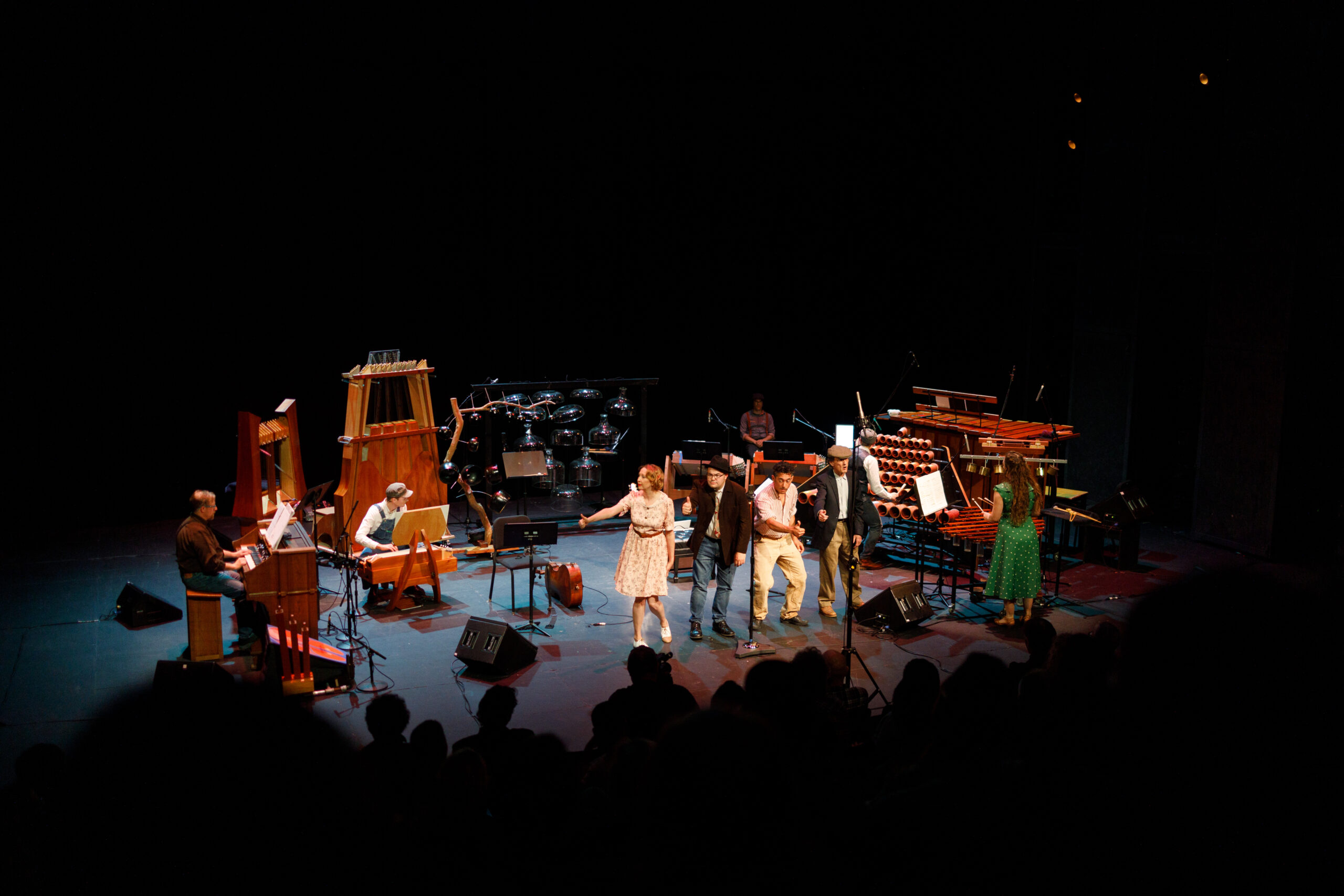
Performed by Partch Ensemble on May 31, 2008
A wild ride in Disney Hall as Music of Microtonal Composer/Inventor Harry Partch Is performed on amazing Instruments by PARTCH, an acclaimed ensemble Under the direction of John Schneider, -Noted Musician, Educator, Founder of Microfest, He hosts the KPFK weekly Radio Show “Global Village” and also hosted the “SOUNDBOARD TV series.
2014 Grammy Winner: Best Classical Compendium
2014 Grammy Nominee: Best Chamber Performance
No performances (yet…)
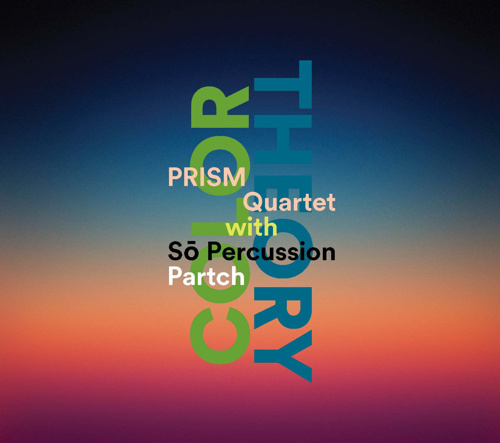
by PRISM Quartet and Sō Percussion
Music for Saxophones, Percussion and Harry Partch Instruments
(more…)World Premiere by PARTCH Ensemble at REDCAT, June 2024
“Reið (Raidō) II is the sixth in a cycle of chamber pieces I have been composing for the last several years where each work is associated with a specific ancient Runic symbol. “Reið (Raidō)” directly translates to “ride” or “journey.” A journey on horseback is implied, but this can also be interpreted as an experience which connects this life with the afterlife, or this realm with other realms of existence or consciousness. The repetitive and percussive nature of a galloping horse is often further associated with shamanic drumming that accompanies certain primordial esoteric practices. In my work Reið (Raidō) there are 3 groupings of instruments and players, conveying three types of microtonal tunings: a Chromelodeon, tuned to a 43-note division of the octave based on ratios derived from just intonation; a piano and a harp whose standard equal temperament is tuned apart by the difference of a 7th partial of the overtone series, or approximately in equal tempered 1/6th tones; and 3 percussionists who play a variety of indefinite pitched or noise-based percussion instruments. In this dramatic representation of both an ancient and futuristic ritual, these various tunings and timbres are utilized through a carefully controlled harmonic, motivic, and formal personal language, that unifies structure and architecture with intensity and expression.”
— Jeffrey Holmes
This performance was made possible in part by a grant from the City of Los Angeles Department of Cultural Affairs.
This performance was also made possible in part by the Los Angeles County Board of Supervisors through the Department of Arts and Culture.
Performed by PARTCH Ensemble at REDCAT, June 2024
Those instruments were also explored in Partch’s chimerically titled suite of twelve compositions called Intrusions. This subset of five include his Two Studies on Ancient Greek Scales that were originally for solo Harmonic Canon, to which he later added a bass marimba obligatto. Another Canon was strung and bridged in his 43-note octave from C#3-C#4 for The Wind whose hyperchromatic arpeggios hauntingly evoke two moods of that natural phenomenon that can both caress or destroy. The first text comes from the pen of Irish born poet Ella Young who lived in the Bay Area for many years, with the second from 6th century Chinese poet/philosoper Lao Tze that Partch had previously set in his 1935 memoir Bitter Music. In The Street, the chilly wind that blows over the jails and cartracks of Chicago sets the final paragraphs of Willard Motley’s 1947 best seller Knock on Any Door that describes a young Italian immigrant’s downward spiral from altar boy to criminal. And finally, Ella Young—also a Celtic mythologist who believed in fairies, pixies, and praised the benefits of talking to trees— returns to interrogate The Waterfall, curious as to why it would possibly seek oblivion after such a vivacious life in the sunlight.
— JS
This performance was made possible in part by a grant from the City of Los Angeles Department of Cultural Affairs.
This performance was also made possible in part by the Los Angeles County Board of Supervisors through the Department of Arts and Culture.
“LSD: Huxley’s Last Trip,” an opera with music by Anne LeBaron and a libretto by Gerd Stern, Ed Rosenfeld, and Anne LeBaron, charts the powerful cultural, political, and spiritual forces ignited by Albert Hofmann’s discovery of lysergic acid diethylamide. Represented by three sopranos, the LSD Trio (Love, Sex, and Death) embarks on a journey, encountering a diverse cast of characters influential in science, literature, entertainment, national security, and politics. The four scenes on this video represent about half of the opera. (For the remaining scenes, see “LSD: The Opera” on this YouTube channel.)
Performances took place at REDCAT in downtown Los Angeles on June 14-15, 2024.
Librettists: Gerd Stern, Ed Rosenfeld, and Anne LeBaron
Bass & Diamond Marimbas ~ Boo ~ BloBoy ~ Castor & Pollux Canons ~ Chromelodeon ~ Kithara II ~ Surrogate Kithara ~ Spoils of War
“A collection of musical compositions based on the spoken and written words of hobos and other characters—the result of my wanderings in the Western part of the United States from 1935 to 1941.”
~ Harry Partch on The Wayward
In 1957, Partch described this final version of U.S. Highball as, “…the most creative piece of music I ever wrote, and in the sense that it is less influenced by the forms and attitudes that I had grown up with as a child and experienced later in adult life, there can be no doubt of it.” The initial version was sketched out with guitar & solo voice, followed six months later by an expanded version for voice, guitar, kithara & chromelodeon. But he soon realized that the work really needed percussion instruments, and nine years later, he created the work you hear tonight. It describes his 1941 two-week freight-hopping, hitch-hiking & pot walloping journey from Carmel, California to Chicago in search of a new life and recognition of his music:
“It was the second day out of San Francisco that I began jotting down words in this notebook: fragments of conversations, remarks, writings on the sides of boxcars, signs in havens for derelicts, hitchhiker’s inscriptions, names of stations, thoughts…These fragments ARE the text of U.S. Highball… The work falls naturally into three parts: first, a long and jerky passage by drags to Little America, Wyoming: second, a slow dish-washing movement at Little America; third, a rhythmic allegro by highway to Chicago. The one word—Chicago—is the end of the text. Instrumentally, what follows implies a tremendous letdown from the obstinately compulsive exhilaration of getting to Chicago. It implies bewilderment, and that essentially dominant question in the life of the wanderer — what next?”
But the story doesn’t end there: following the 1958 release of the recording on Partch’s own Gate 5 label, he and filmmaker Madeline Tourtelot shot a studio performance of the work, and a decade later interspersed those black & white scenes with color footage of trains, roads, scenery traversed, and even abstract art. The 24-minute art house film still makes quite an impression, and is easily viewable online.
World premiere choreography by Sarah Swenson
Performed by Cheryl Banks-Smith, TamsinCarlson, Queala Clancy, Tori Cone, Miranda Cox, and Sarah Swenson
Perhaps the only ‘triple exposure’ in music history, Partch called this infectious dance music, “A tribute to the twin stars of luck. Atonal-dynamic dithyramb. A ritualistic ecstasy…In Castor each of the first three sections requires pairs of different instruments and dancers, all three of which have identical measure patterns, but not necessarily the same rhythms. Number 4, then, is the total of these, played and danced simultaneously. Thus, three different compositions become one composition—the “Delivery,” the logical result and the sum total of the factors that make it inevitable. Pollux follows the same plan: Numbers 5, 6, and 7 combined to result in Number 8.”
by PRISM Quartet and Sō Percussion
Music for Saxophones, Percussion and Harry Partch Instruments
Continue reading “Color Theory (2017)”Color Theory Concert: PRISM Quartet and Partch
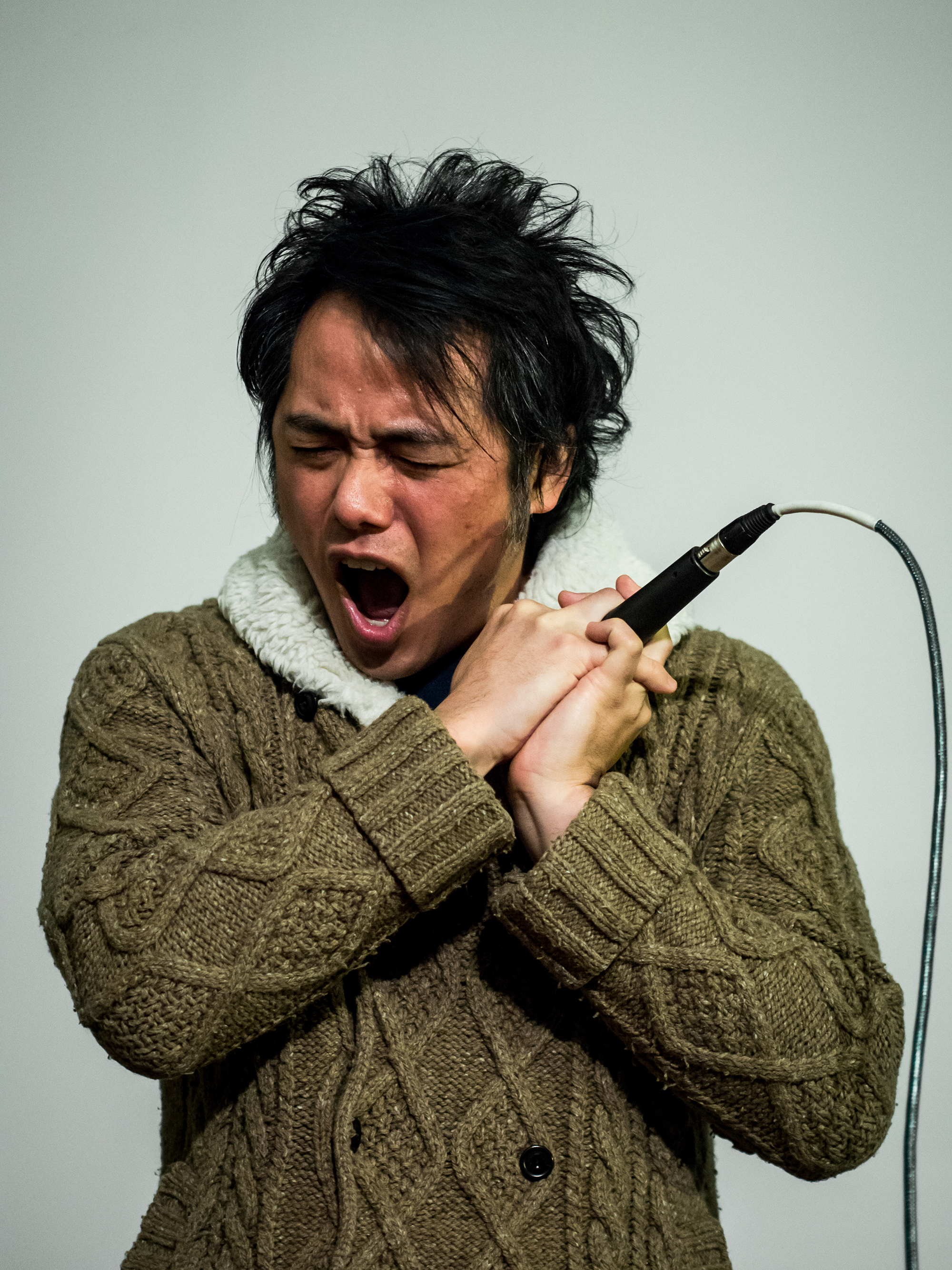
Ken Ueno: My work, “Future Lilacs,” metaphorically connects to color theory in blending different temperaments. It is the scientific reduction of sounds to a common denominator (thinking in terms of frequencies rather than scales) that helps me with this approach, which I consider a Newtonian way of rationalizing the ineffable.
June 12, 2016
Co-Presented by PRISM Quartet and Roulette
PRISM Quartet and Partch (East Coast Debut)
CASTOR & POLLUX (1952) by Harry Partch (1901 – 1974)
A Dance for the Twin Rhythms of Gemini
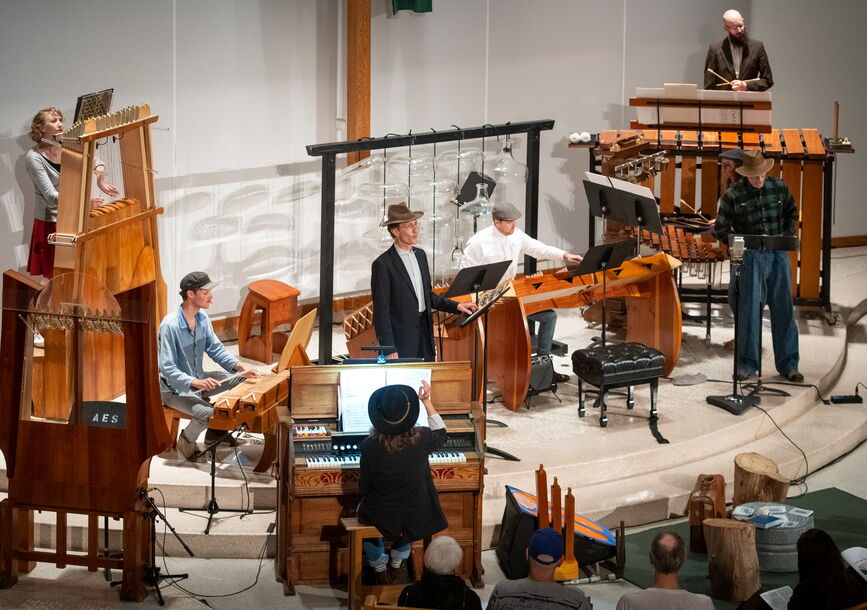
John Schneider introduces PARTCH Ensemble’s instruments to USC students.