Videos
No videos (yet…)
Performances

Recordings
No recordings (yet…)
No videos (yet…)
No recordings (yet…)
No videos (yet…)
No recordings (yet…)
Live at REDCAT, June 16-17, 2023
Program note by Kyle Gann:
As a long-time microtonalist, I’ve always wanted to write something for the Harry Partch instruments, so I am extremely grateful to John Schneider for offering me the chance. My idea was to prove, or perhaps I should say test, the universality of Partch’s ensemble by trying to write in a style that didn’t sound like Partch. Accordingly, I concentrated on the microtonal relationships among the various harmonies, and had to wrestle with the fact that not all of his instruments had the same pitches. After fifty years of composing, I was made to feel like a rank amateur in this totally idiosyncratic environment, and as Partch inveighed against his performers looking like an “amateur California prune picker,” I thought I should embrace the title. Were I to attempt a second essay, I would probably surrender and write “à la Harry.” — K.G.
No recordings (yet…)
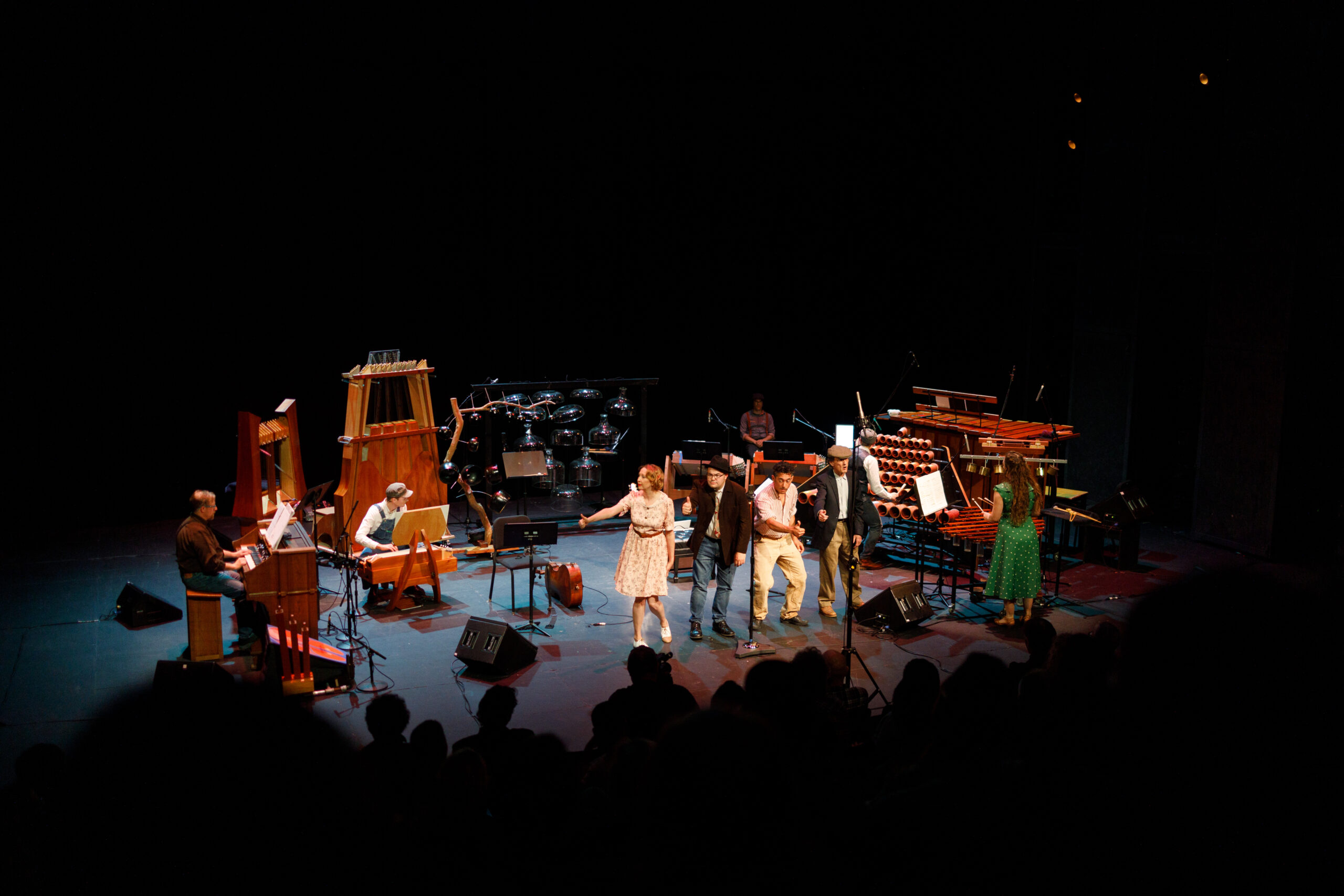
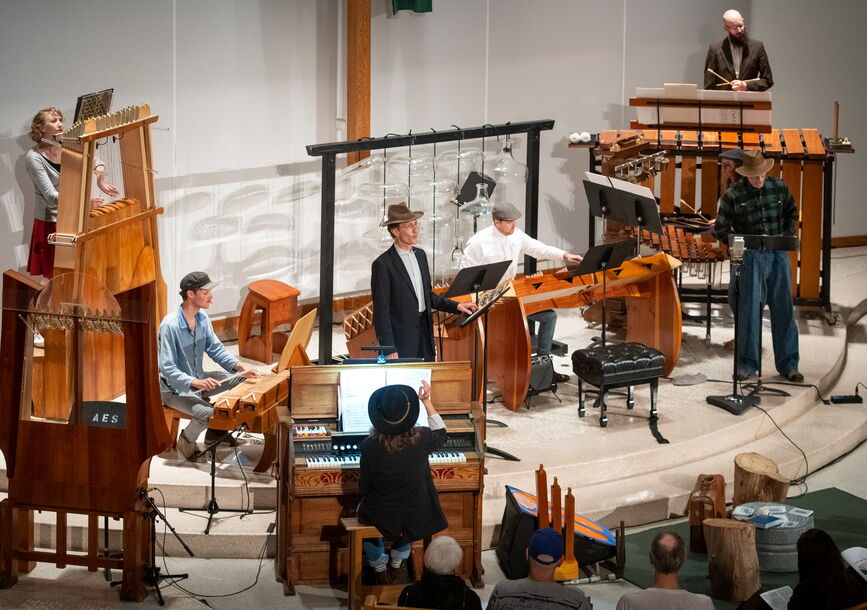
Bass & Diamond Marimbas ~ Boo ~ BloBoy ~ Castor & Pollux Canons ~ Chromelodeon ~ Kithara II ~ Surrogate Kithara ~ Spoils of War
“A collection of musical compositions based on the spoken and written words of hobos and other characters—the result of my wanderings in the Western part of the United States from 1935 to 1941.”
~ Harry Partch on The Wayward
In 1957, Partch described this final version of U.S. Highball as, “…the most creative piece of music I ever wrote, and in the sense that it is less influenced by the forms and attitudes that I had grown up with as a child and experienced later in adult life, there can be no doubt of it.” The initial version was sketched out with guitar & solo voice, followed six months later by an expanded version for voice, guitar, kithara & chromelodeon. But he soon realized that the work really needed percussion instruments, and nine years later, he created the work you hear tonight. It describes his 1941 two-week freight-hopping, hitch-hiking & pot walloping journey from Carmel, California to Chicago in search of a new life and recognition of his music:
“It was the second day out of San Francisco that I began jotting down words in this notebook: fragments of conversations, remarks, writings on the sides of boxcars, signs in havens for derelicts, hitchhiker’s inscriptions, names of stations, thoughts…These fragments ARE the text of U.S. Highball… The work falls naturally into three parts: first, a long and jerky passage by drags to Little America, Wyoming: second, a slow dish-washing movement at Little America; third, a rhythmic allegro by highway to Chicago. The one word—Chicago—is the end of the text. Instrumentally, what follows implies a tremendous letdown from the obstinately compulsive exhilaration of getting to Chicago. It implies bewilderment, and that essentially dominant question in the life of the wanderer — what next?”
But the story doesn’t end there: following the 1958 release of the recording on Partch’s own Gate 5 label, he and filmmaker Madeline Tourtelot shot a studio performance of the work, and a decade later interspersed those black & white scenes with color footage of trains, roads, scenery traversed, and even abstract art. The 24-minute art house film still makes quite an impression, and is easily viewable online.
Live at REDCAT, June 16-17, 2023
Program note by Kyle Gann:
As a long-time microtonalist, I’ve always wanted to write something for the Harry Partch instruments, so I am extremely grateful to John Schneider for offering me the chance. My idea was to prove, or perhaps I should say test, the universality of Partch’s ensemble by trying to write in a style that didn’t sound like Partch. Accordingly, I concentrated on the microtonal relationships among the various harmonies, and had to wrestle with the fact that not all of his instruments had the same pitches. After fifty years of composing, I was made to feel like a rank amateur in this totally idiosyncratic environment, and as Partch inveighed against his performers looking like an “amateur California prune picker,” I thought I should embrace the title. Were I to attempt a second essay, I would probably surrender and write “à la Harry.” — K.G.
Live at REDCAT Theater in Los Angeles on June 17, 2022.
Program note by Taylor Brook:
The title of this work refers to a fascinating chart in Harry Partch’s Genesis of a Music: “The One-footed Bride.” Resembling the outline of a foot, this chart marks out just intervals and their inversions along either side of a central axis. In this chart, one finds diatonic interval regions associated with expressive qualities; seconds and sevenths with “approach,” thirds and sixths with “emotion,” perfect fourths and fifths with “power,” and the tritone region with “suspense.” While highly subjective, there’s a certain intuitive sense to these pairings. Even more fascinating for me was how Partch fits his 43-note scale into a diatonic structure. What this suggests is that we might understand the many intervals of Partch’s scale as shadings within each region. This became the foundation of my piece, One-footed: an exploration of the expressive potential of thinking about pitch and interval in this way. The instrumentation for One-footed combines a string quartet with many of Partch’s famous instruments. As a composer writing in 2021 I enjoy the legacy of composers like Partch and Ben Johnston, where performers like the Del Sol Quartet now deeply understand just intonation, and I see the PARTCH ENSEMBLE as a whole new type of orchestra that can finally be bridged to as a result. One-footed was written for the combined forces of Del Sol Quartet and PARTCH Ensemble in 2020-2021.
This performance was made possible in part by a grant from the City of Los Angeles Department of Cultural Affairs.
We also acknowledge the support of the Canada Council for the Arts.
PARTCH Ensemble Artistic Director John Schneider discusses the Spoils of War with T.J. Troy, detailing the evolution and application of the most complex and seemingly disparate instruments invented by American Maverick composer Harry Partch.
This video is made possible in part by a grant from the City of Los Angeles Department of Cultural Affairs.
Live at REDCAT, June 2015
Partch’s delightful setting from Lewis Carroll’s ALICE’S ADVENTURES IN WONDERLAND was written for a performance of the Young People’s Concert Series of the Mill Valley Outdoor Club in February 1954, coupled with “O Frabjous Day!”