Erin Barnes

[Composer Harry] Partch made a big point of the corporeality of music. HIs instruments and tunings were intended to reach a listener physically…[Partch] wanted performers who were physical presences…and he got them in the likes of Erin Barnes.

Mark Swed, Music Critic, Los Angeles Times

The California Institute of the Arts is one of few accredited institutions in the world that feature music curricula beyond the scope of what is found in a traditional conservatory environment: CalArts boasts programs specializing in North Indian (Hindustani) Classical Music, Balinese and Javanese Gamelan, and Ewe Drumming from Northern Ghana, collectively dubbed World Music Studies. It’s one thing to hear music from these regions and be moved, but another thing entirely to practice these art forms under the guidance of the established masters of the genre; CalArts offers the opportunity to experience both, in significantly meaningful ways.

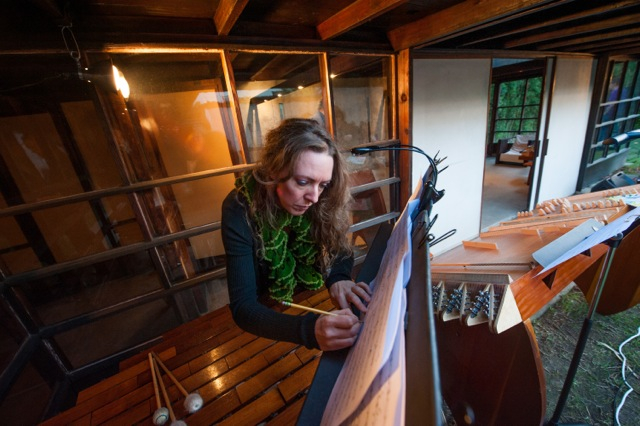
As a percussion major at CalArts in the 1990s, Los Angeles-born and raised percussionist Erin Barnes was exposed to all this and more. Early on in her CalArts tenure, her interest in instrument building led her to discover alternative concepts of intonation, and an introduction to the work of Los Angeles-based composer and musicologist Kraig Grady. Kraig’s own brand of microtonal string and percussion music was firmly rooted in theories set forth by (amongst others) composer Harry Partch, and it was through this collaboration that Erin Barnes was first introduced to Partch’s music, and ultimately led to her to the Diamond Marimba, a fixture in virtually every performance of the PARTCH Ensemble.

“It was…1998, but I think the first piece I heard (of Harry Partch’s) was And on the Seventh Day Petals Fell in Petaluma, or Daphne of the Dunes,” says Erin, when recalling her first experience with Partch’s music. “At that time, I was also deeply immersed in the world of dance, taking several ballet and modern classes a week…When I started playing Partch’s music, I had no idea about his philosophy of corporeality and music. Castor and Pollux, a highly physical piece, was the first piece I learned as a part of this group, and naturally I found myself moving around the instrument a lot. When I later learned that Partch wanted his musicians to move, to have a strong physical connection to the music, it made complete, perfect sense, and I felt deeply that I had found my perfect artistic match.”
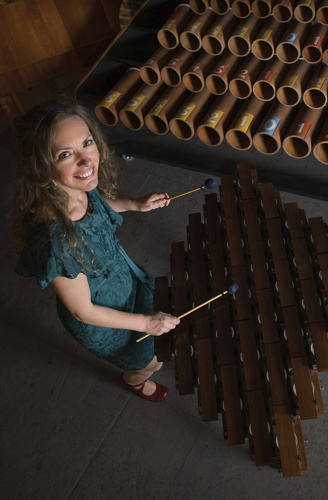
“When I later learned that Partch wanted his musicians to move, to have a strong physical connection to the music, it made complete, perfect sense, and I felt deeply that I had found my perfect artistic match.”

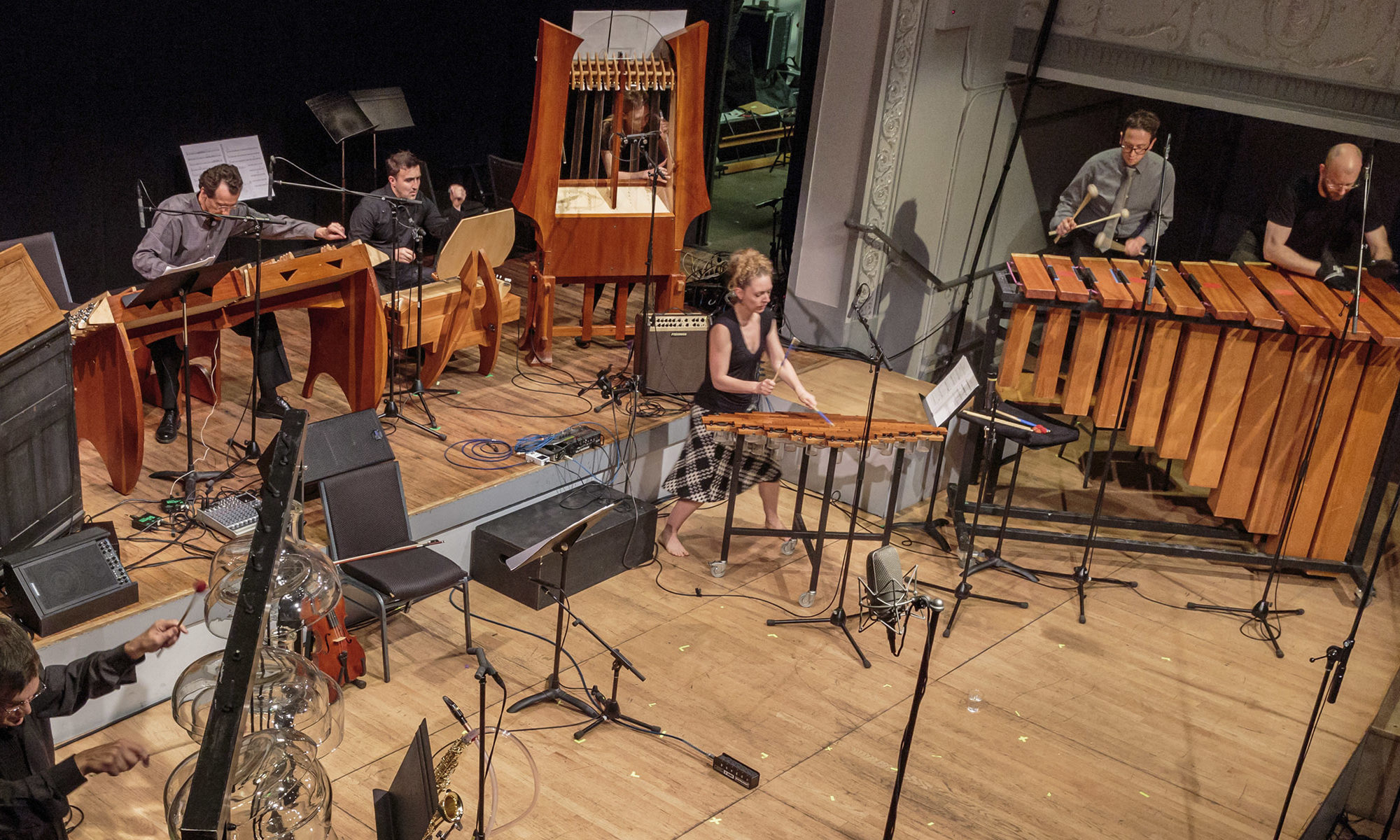
Indeed, Erin’s command of the corporeal Diamond Marimba has become one of the great highlights of all PARTCH Ensemble performances since joining the group in 2003; at that time, the ensemble was but three people, still performing under the name of founder John Schneider’s group Just Strings. Together with Schneider and fellow percussionist (and CalArts mentor) David Johnson, the group performed for two more seasons, recruiting current members Nick Terry and T.J. Troy along the way, before officially establishing the ensemble now known as PARTCH in 2005.

Beyond the microtonal world of PARTCH, Erin is active in many different musical and educational capacites in the Los Angeles area, performing on the hammered dulcimer, focusing on traditional Celtic, Swedish, and American “Old Time” string music. Recent projects include a return to 1920s Xylophone and novelty Piano music (which also require a 1920s era xylophone, a sudden and preoccupying obsession!). She currently serves on the faculty of the Pasadena Waldorf High School, leading their Percussion Ensemble, and coaches the Violin and Cello sections of the Pasadena Youth Symphony Orchestra. Additionally, Erin is a trained yoga instructor, her work focused on elderly practitioners.

Yet, it is the spirit of invention championed by Harry Partch himself that engages Erin on a fundamental level, revealing deeper musical meaning through her experiences with PARTCH Ensemble. “The most meaningful memory” she shared, ”…probably my deepest experience as a musician and human being…happened to be with PARTCH.

“We were at UC Santa Cruz, having played the previous night at Mills College to a large and enthusiastic audience. The Santa Cruz audience was smaller than Mills’, and maybe this set the scene for a more relaxed performance. For a fleeting moment, while playing Pollux (possibly my favorite music to play, ever), I experienced a clear and deep feeling of complete oneness between the music, the sound of the instrument resonating in the hall, myself, and the audience. It was such a calm, powerful, and beautiful moment, and as it occurred, I realized I was conscious of it.”

While music’s power to transport and inspire imagination has been documented repeatedly throughout all eras of human existence, it is the transformative aspects of music that are more elusive; more likely than not, it’s because the unique nature of these experiences leave little to compare to another’s. Regardless of what inspirations brought Erin Barnes to the music of Harry Partch, it is our PARTCH Ensemble that benefits from her inspiration to stay there, to keep searching for the deeper parallels, the resonances that reach across decades and across people, to arrive at a place where the corporeal interacts with the spiritual…this is where Harry operated, and in that space, Erin Barnes continues to dazzle with the pure physicality that is music in motion.

“I truly appreciate this group as a mix of wonderful musicians…I feel like I learn so much from everyone in this ensemble. As for Harry, there really is no other music like his.”
PARTCHed – February 2019

re-Genesis of a Music
  ~  A tale of obsession  ~

 by John Schneider

Part II: “Seduced into Carpenty…”

There I was, back in 1991: in one hand a photocopy of a heretofore unknown copy of the original version guitar/voice version of my favorite Partch piece Barstow: Eight Hitchhiker Inscriptions (1941). In the other hand, I held his book Genesis of a Music, the Rosetta Stone that would enable me to interpret the enigmatic fractions that covered the score. It had been handed to me years before by Partch’s longtime assistant and collaborator Danlee Mitchell who had warned me, “It’s unplayable – the instrument is gone and there are no recordings.” (It would take me many decades to realize that neither of those things were actually true.) But as a classical guitarist, I was used to transcribing music from other instruments, and as the owner of several refretted guitars, surely I could make this piece work on a custom fingerboard…If I could only figure out what those numbers meant, I could turn them into notes, then frets, then actual tones. 

From Genesis, I soon discovered that those fractions were actually ratios, describing  the relationship between two pitches. In Partch’s world, everything relates back to the pitch G, and that was called 1/1. For example G3, the “G” below middle-C, vibrates at 196 times a second (Hertz or Hz). The so-called octave above it vibrates at twice that speed (G4 = 392Hz), so Partch would call that note a 2/1, that is, the higher note vibrates two times for every single vibration of the lower G. A Perfect 5th is another relationship: the D4 above G3 vibrates 3 times every time the lower note vibrates twice, so the ratio of a perfect 5th = 3/2. A major 3rd = 5/4, minor 3rd =6/5, minor 7th = 7/4, and so on. In fact, Partch made an exhaustive list of hundreds of intervals found within an ‘octave’ and listed them in Genesis, also measuring them in Cents – a unit of measurement that = 1/100th of an equal tempered semitone. I was already used to measuring ‘microtonal’ versions of equally tempered notes from playing the refretted guitar music of Lou Harrison for years, so no problem there. Through that experience, I also knew that there were many versions of the ‘same’ note, depending on its function. The C a major third above Ab would need to be 16¢ lower than the C a perfect 5th above an F, while the C a minor 7th (7/4) above a D, for example, would need to be 31¢ flatter, etc. 

Once Partch had discovered the exact pitches of pure intonation, he could no longer use what he referred to as the “Alice in Wonderland mumbo-jumbo” of alphabetical Western notation. For his music, always tuned to ‘just’ intonation,

“The only, clear, logical, rational terms are numbers – the relationships of numbers. That is, frequency ratios or the ratios of parts of sounding bodies… The word ‘octave’, for example, is a palpable imprecision…used to describe a physical distance on the modern keyboard….the aural quantity (is described by) the correct term, the ratio of two to one [2/1]. The terms septimal whole tone, septimal minor third, septimal tritone sound delightfully erudite – but in fact, the terms 8/7, 7/6 & 7/5 are far more meaningful.” 

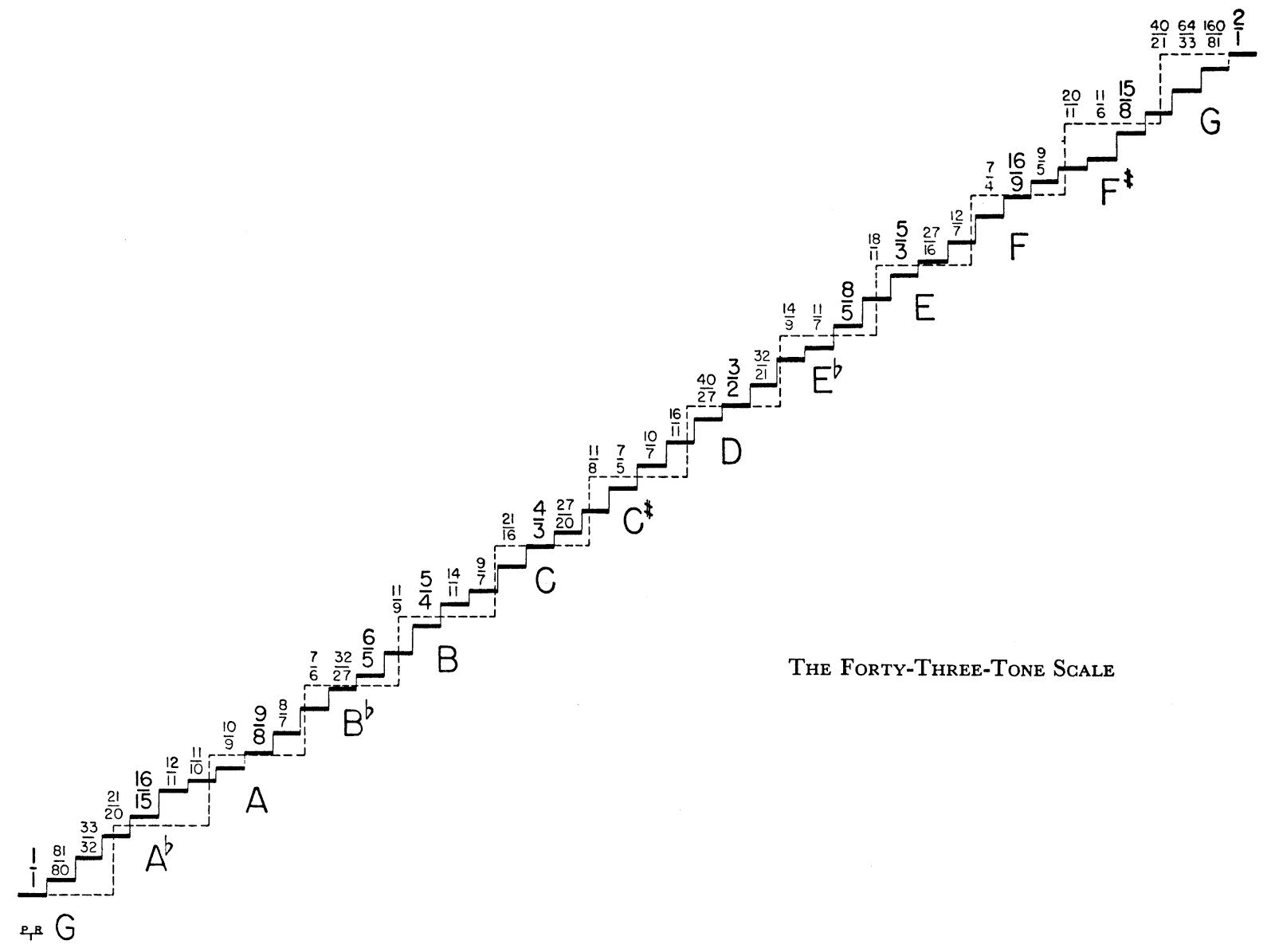
The resulting scale looks like this, with each ‘note’ fine-tuned by several ratios:

Partch Scale.tif

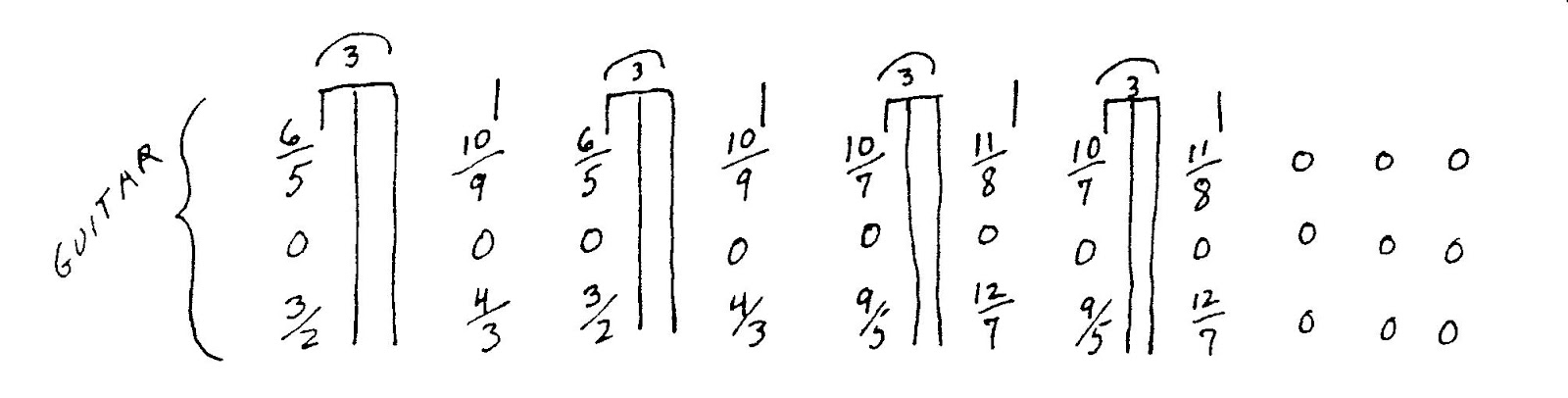
All of a sudden, the opening ritornello of Barstow started to make a little more sense: 

Barstow Ritornello

But what were the 0’s? open strings? Back to Genesis:

I purchased my original guitar in 1934 and spent several years (1934-1942) in the effort to evolve effective frets in Just Intonation. The usual low, wire-type frets were not very satisfactory, and I eventually fitted high, stainless-steel frets into slots in a brass plate, which was then screwed onto the neck. Both Barstow and U.S. Highball were originally written for this guitar, and I played it in performing these pieces for some two years…(it is) tuned in three pairs of 2/1’s, the lower tone of the middle pair being 1/1-98, the pitch of the lowest string on the Adapted Viola. [G-98Hz] 

The three lowest strings and the three highest strings (a 2/1 above) are separated by successive 5/4’s. Partly because of this pairing of strings, the instrument is played more like a mandolin than a guitar, but its low range of pitch and 2/1 pairs contribute to a result that is unlike either.

So the open strings were Eb2-Eb3-G2-G3-B2-B3, making the opening triplet chord a G-minor chord: the 3/2 = D, O = open G-strings, and the 6/5 = Bb on the highest course, etc, with the last three chords representing all strings played open.

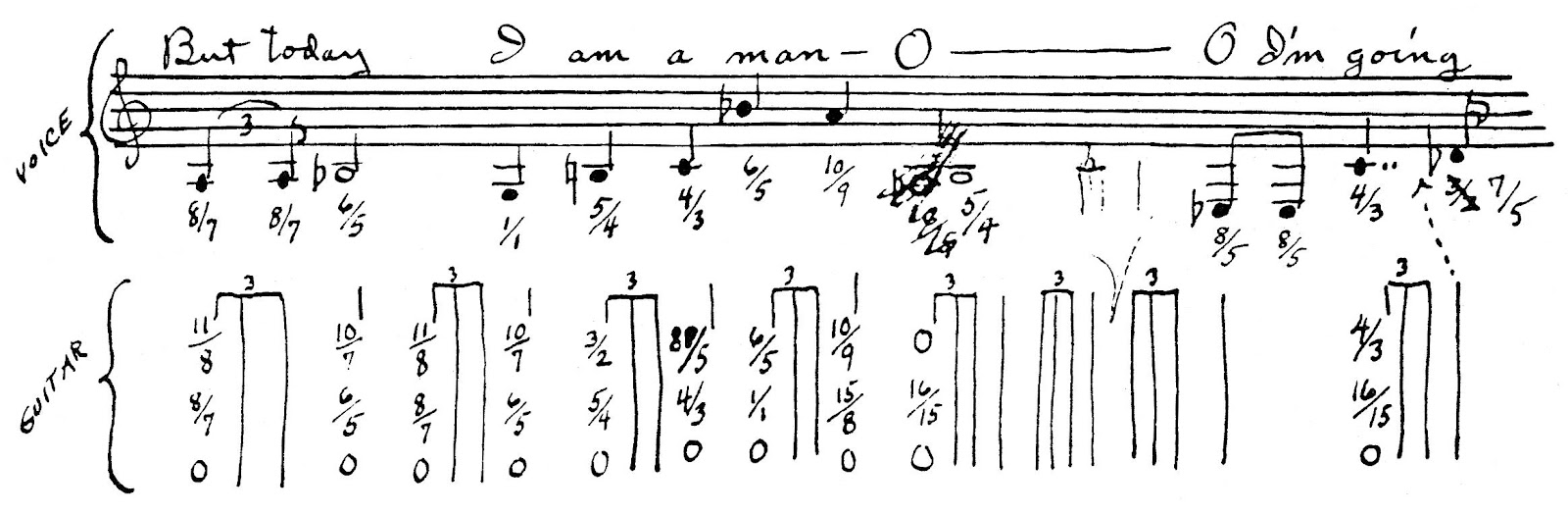
Grabbing a pencil, I dutifully went through the Barstow score and wrote down all of the notes needed to play the guitar part, translating the ratios into pitches. There were eighteen notes to the octave, with four flavors of A, two F#’s, two C#’s, and two E’s. On the next page, the vocal part began. Luckily it was written in standard ‘mumbo jumbo’ notation on a five-line staff and standard pitches, though each standard note had a ratio below it to show how to tune that particular C, Eb, etc. 

Barstow_But Today I am a man.jpg

All in all, both parts needed a total of 39 notes/octave, so armed with that list, I started to transcribe.

I got two pages completed when I realized that there was no way I could play those octave doublings on a standard guitar: the fingerings would be impossible, and I was beginning to realize that his guitar was a steel-strung, not nylon. How could I possibly justify playing this on a classical guitar! The answer was simple: I couldn’t. In an era that demanded ‘authenticity,’ [Bach should be heard on the instruments and in the tunings of his time, not modern Steinways!] I would have re-create the original instrument. A thousand questions flooded my brain: how was such an instrument strung? I now knew it was in three pairs of strings, tuned in octaves like a twelve-string guitar. But how was it fretted? Low frets don’t work? Would I need a brass plate and stainless steel frets? What about the strings? What gauges were used? should the lower octave string of each pair come first, or second….?

Time to answer all those questions and more. And, time to make some sawdust. As Partch had so memorably stated years before,

"I am not an instrument builder,
but a philosophic music, seduced into carpentry" 

Little did I know it then, but I was about to embark on that very same path…a journey that continues to this day. 

Next: “Oh for a picture—just one picture….!”