-
PARTCHed – May 2020
Organ Transplant, pt.4
“Too Many Notes!”
Once Partch had created a working “Chromolodian” in Chicago in 1942, he was finally able to get to work creating the marvelous repertoire that we have come to admire. The instrument, however, was only meant to be a stop gap “instrument of expediency” until he could perfect the so-called “General Keyboard” layout that he had envisaged a decade earlier.
The problem was that with forty-three notes to the octave, his newly adapted standard 61-key, 5-octave reed organ only produced a continuous scale with a range of little more than an octave. The limited tessitura of the “A”-stop could be expanded by pulling the “Z”-stop that engaged a second set of reeds, doubling the notes found on the lowest keys F1-E3 an octave below their initial “A” pitches while pulling the “X”-stop produced those an octave higher than keys F3-F6. Playing the keyboard with just stops Z & X open (without the A-stop) certainly produced a strange discontinous scale when played alone, but they were meant to extend the top to bottom of the initial A-scale.
By 1945, he had adapted a 6-octave, 73-key instrument—changing the name to its final spelling “Chromelodeon”—though that only added a major third to the still rather limited gamut:
Those extra 12 keys also hadn’t solved another basic problem: with so many notes to the octave, playing a simple triad was extremely awkward, taking two hands, compared with the standard keyboard:
So in an effort to create a more hand-friendly keyboard, Partch created an entirely new design, admitting that,
The many impossible stretches on Chromelodeon I in the common harmonic intervals—2/1, 3/2, and 4/3 [octave, fifth, and fourth]—influence the composer toward linear or voice-leading types of music. This is far from a bad influence, but the keyboard distances are limitations which are partially eliminated in Chromelodeon II. This instrument has more keys to the octave in the same octave distance.1re-Genesis of a Music
~ A tale of obsession ~
by John Schneider
-
PARTCH 16, Visitors 7 – CANCELED
Due to the COVID-19 outbreak and moratorium on public gatherings we regret to inform that this concert has been canceled. We will attempt to reschedule for later this year.
-
PARTCHed – December 2019
re-Genesis of a Music
~ A tale of obsession ~
by John SchneiderOrgan Transplant, pt.3
“Have Reeds Will Travel”
Partch returned to the U.S. in April of 1935 after his extraordinary European sojourn. He hitchhiked to New York, visiting the Carnegie Corporation to ensure that his 6-month grant report had been received, and hurried on to the West Coast, eager to meet his organ at the docks where it would arrive via the Panama Canal:
Los Angeles, April 30, 1935. My entire expenses from Malta to London to Portland to Los Angeles have been $150—food and transportation. I have 1% of my $1,500 left.
I spend a week persuading the customs officials to admit the chromatic organ without duty. And, through friends, a way is ultimately found. Its godmother, in Santa Barbara [quartertone composer Mildred Couper 1887-1974], has offered to keep it and pay for its transportation there. Off it goes again, direct from the dock. (Bitter Music)
He ended up eventually removing all of the reeds that he had so carefully tuned in London and began making a new console in an Adult Education night class wood shop at a Los Angeles high school where he also crafted his first Kithara. He finished work on the ‘new’ Ptolemy in 1940 in Big Sur while staying at the Old Convict Camp in Anderson Creek, where he also finished writing his journal Bitter Music:
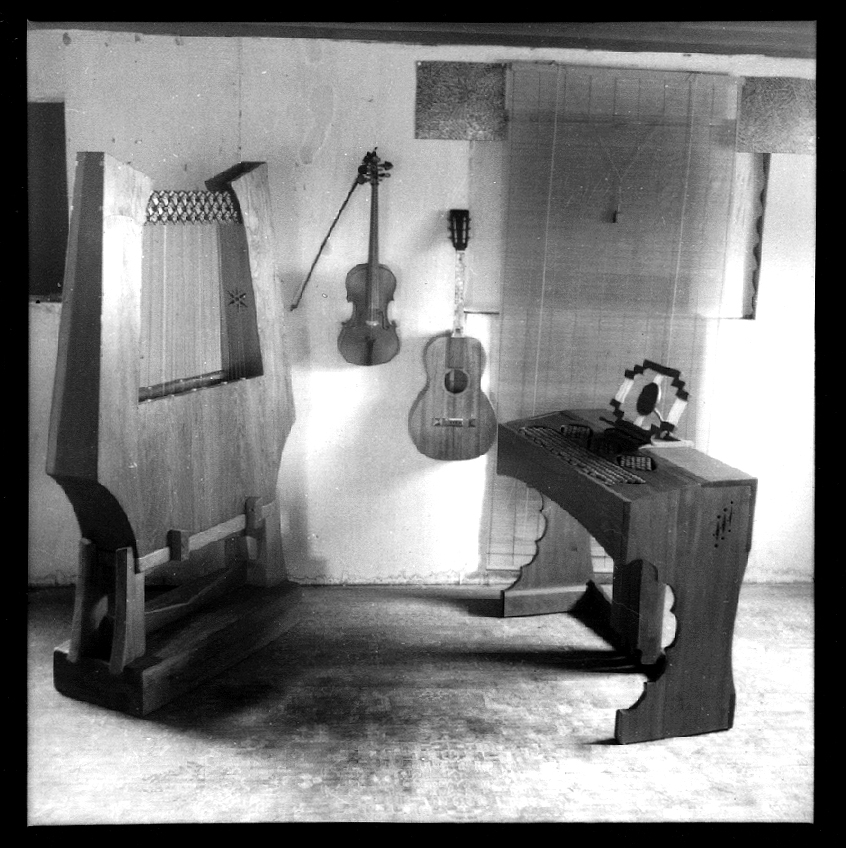
Anderson Creek Studio: with Kithara, Adapted Viola, Adapted Guitar, and
the new Ptolemy (1941)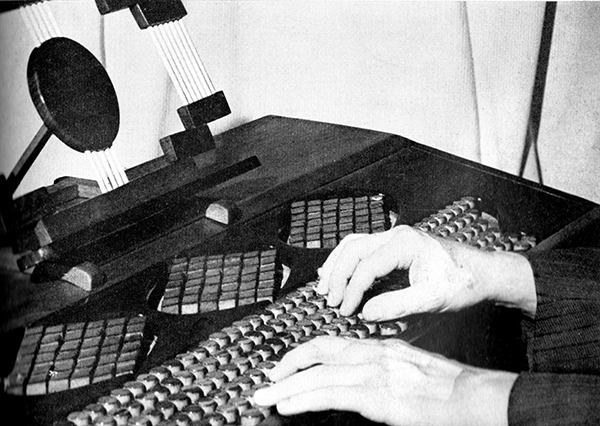
New Ptolemy Keyboard console Sadly, this new incarnation of the instrument was also unsuccessful, though the reeds would travel once again, this time to Chicago where they would find a new home in what became the composer’s “Chromolodian,” the first of many instruments that would bear that colorful name.
Partch’s now famous exodus from the California coast to Illinois—as immortalized in his unforgettable U.S. Highball/A Musical Account of a Transcontinental Hobo Trip—was instigated by an invitation from a Chicago music lover. Years later, in his typically sardonic retelling, the composer remarked, “Having been through more than six years of California depression, I jumped at the chance to see some Midwest depression (somewhat like a prisoner in the county jail eagerly looking forward to a transfer to the county farm, or vice versa).”
His arrival on October 1, 1941 “…in the dingy, pre-dawn smogginess of industrial Chicago (Genesis),” certainly didn’t dampen his spirits, as just seven weeks later, he was performing Barstow and a few of his Li Po Lyrics at Chicago’s School of Design, sharing the program with a younger California composer named John Cage.
In the coming months, he printed a promotional brochure that described—in the 3rd person—his biography, list of works and instruments. The title page read:
Presenting a Resume of
The Music Philosophy and Work of Harry Partch
Composer — Instrument Builder and Player — Theorist


A Modern Renascence of
the most ancient of civi-
lized Musical Ideals  -


SPEECH-MUSIC
In    a Flexible    Scale
Utilizing new instruments having a
gamut of 43 true tones to the octave.
In it, he describes the nascent Chromatic Organ—née Ptolemy—but goes on to describe it’s expedient surrogate:
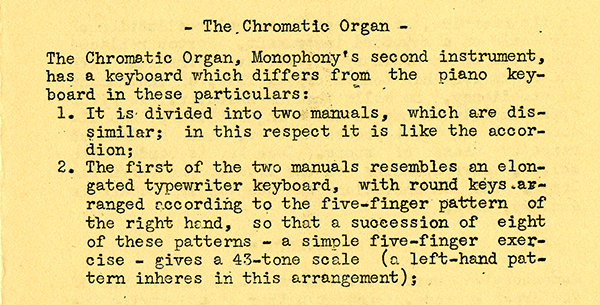
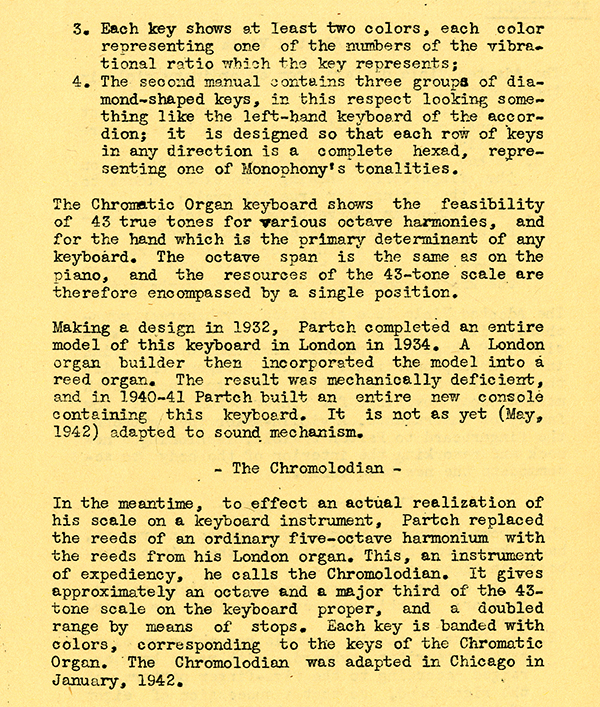
Clearly keen to continue his compositional projects, Partch first attempted to adapt an old melodeon (a type of reed organ) that was loaned to him by two harpsichordists that he had recently met. This was, of course, the inspiration for the eventual name of this Adapted organ, in spite of the preliminary spelling, “Hence the name, a melodeon that approaches closer to the chromatic maximum of all “colors,”or gradations of tone (‘Panchromelodeon’).”
The results must have been unsatisfactory, however, as he soon obtained a standard 61-key/5-octave harmonium, replacing its reeds with those he had retuned in London, and using it to compose the second draft of Barstow between December and January. This new version added the keyboard part and another voice, and though the score has been lost, the title page of his original solo manuscript reflects the additions:
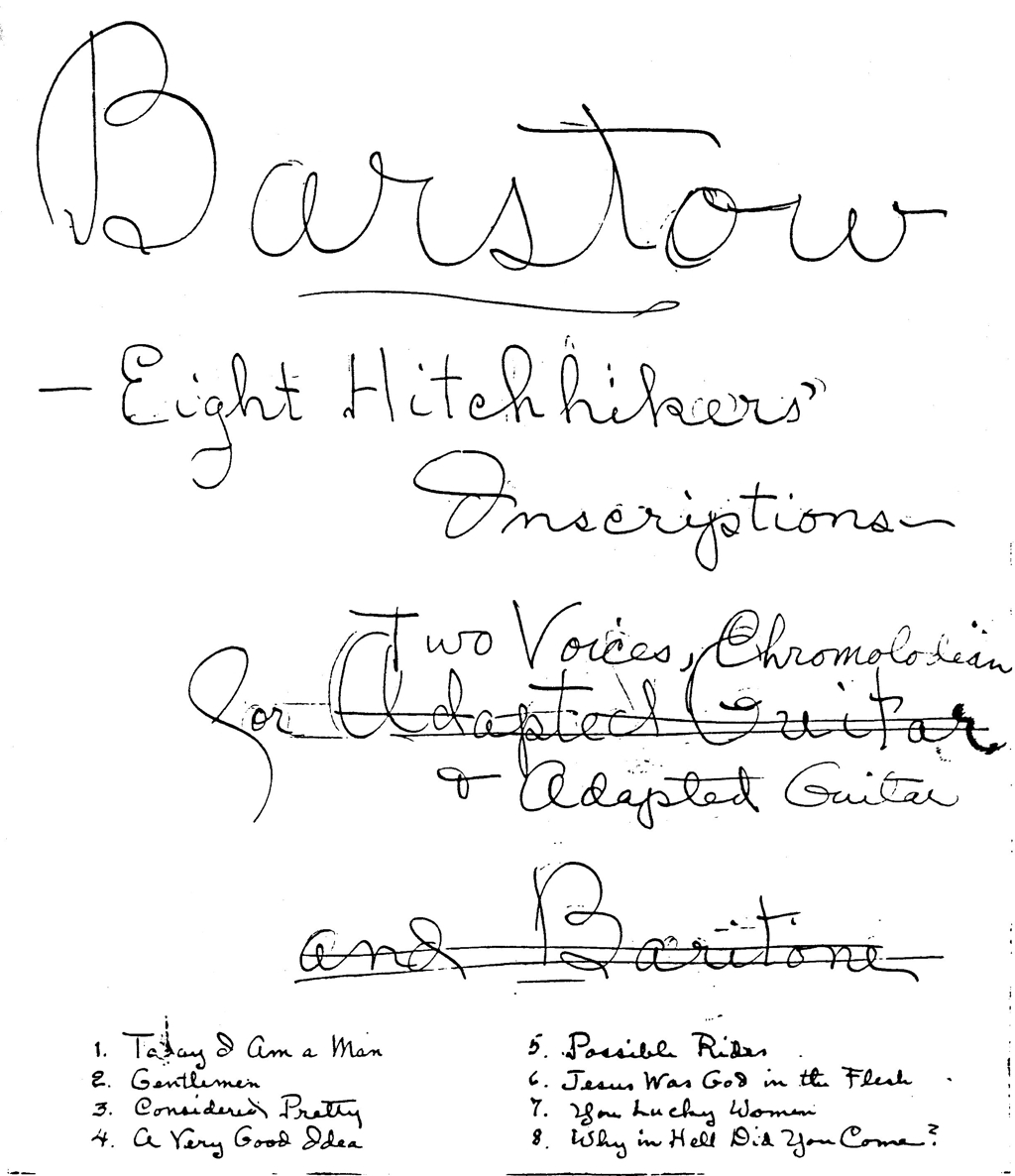
He also transcribed his Two Psalms (1932), “The Lord is My Shepherd,” and “By The Rivers of Babylon,” replacing the original Adapted Viola part with the new keyboard.
By the end of February 1941, Partch began performing these pieces along with Six Lyrics by Li Po (voice & Adapted Viola) with two new Chicago acquaintances, organist Gilman Chase & a young tenor called George Bishop. In March, they even recorded them with recording equipment borrowed from the same kind gentlemen that loaned him the melodeon, though Partch was unhappy with the results, writing to one of the officers at the Guggenheim Fund that he, “was not able to experiment to any appreciable extent with placings of the microphones and instruments.” That was not the case the following November when his solo lecture demonstration at the Eastman School of Music produced six excellent 12-inch acetate discs that were forwarded to the Guggenheim in support of the composer’s upcoming grant application.
Partch used the Chicago-adapted Chromolodian for another three years, in spite of shipping damage that occurred when sending it further east for lectures at Bennington and Eastman. This prompted a comment in a letter to Otto Luening, his Bennington host, “All my shipments were damaged. I’ll just have to do something about it. If I could only find a portable reed organ—one that folds up like a suitcase—to adapt, my biggest problem would be solved. I have priced them, but the cheapest I could find was $65. They’re very popular with sidewalk evangelists.”
The instrument survived all of his presentations and—after some repairs in Boston in December ‘43—was featured in his historic debut at Carnegie Hall on April 22, 1944 when The League of Composers presented
A PROGRAM OF COMPOSITIONS ON AMERICANA TEXTS
by HARRY PARTCH

Artists

Ethel Luening — Soprano        Alix Young Maruchess — Kithara

Henry Brandt — Chromolodeon, Tin Flutes and Tin Oboe

Harry Partch — Intoning Voice, Adapted Guitar, Adapted Viola,
Chromolodeon, Flex-a-tone
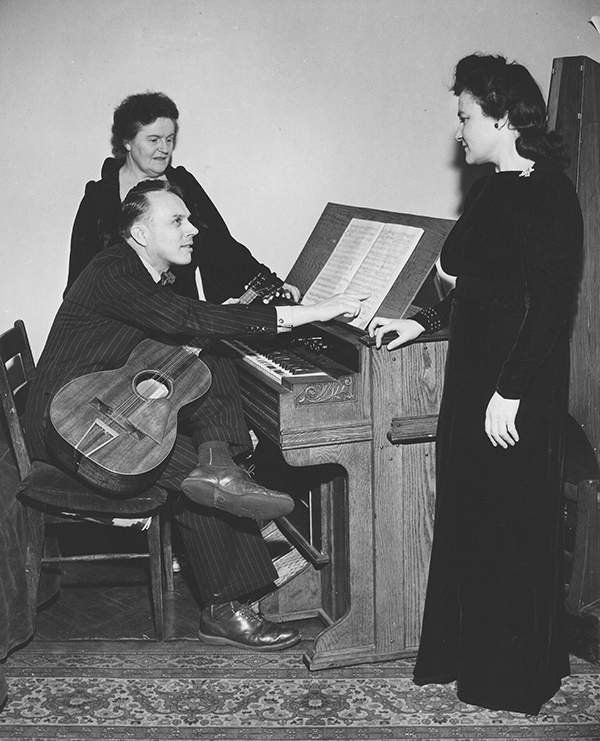
Partch & musicians rehearsing for Carnegie Hall, 1944 Notice that the keyboard formerly known as Chromolodian had changed its name, but many more changes were on the horizon. In the following decade, the rechristened Chromelodeon would change much more that that!
-
PARTCHED – October 2019
re-Genesis of a Music
~ A tale of obsession ~
by John SchneiderOrgan Transplant, pt.2
“This is no musical instrument…!”
In 1934, Partch was awarded a grant of $1,500 from the Carnegie Corporation for a year of research in Europe. It became a most amazing odyssey during which he spent many weeks at the British museum digesting ancient and modern volumes on music, visiting the South Kensington Museum where he saw the microtonal organs constructed by Colin Brown, Bosanquet, and General Perronet Thompson that he had only read about in Helmholtz’s Sensations of Tone:

Colin Brown’s Voice Harmonium

Bosanquet’s Enharmonic Harmonium
He also met early music specialists Arnold Dolmetsch and Kathleen Schlesinger, as well as the poets Ezra Pound and W.B. Yeats. As Partch reminisced in his journal Bitter Music:
“This is money and a consummation in the recognition of my endeavors that have been long coming—eleven years of effort and three years of begging are behind it—and I wonder if I still have the energy, having spent so much in winning the award to execute my projects:
Project 1: Completion of my Trails of Music, the theoretical basis of my work. I had rewritten this manuscript almost every year since 1926, but the historical background was still woefully deficient, and I proposed to prepare histories of intonation, and of the spoken word in music, at the British Museum in London.
Project 2: The building of a true chromatic organ, or, if this is a misuse of the word true, an organ at least three times as chromatic as the piano. The keyboard of this instrument I had already constructed, as a model.
Project 3: the setting of the entire drama King Oedipus, version by the Irish poet William Butler Yeats, to my music, preserving throughout the vitality of the spoken words…
I could spend the whole sum of $1,500 on my chromatic organ—my beautiful dumb keyboard—in a single disbursement, and waste no part of a penny. After all, people spend a thousand dollars on a piano, which is standardized and in mass production, and think nothing extravagant in it. And yet for my keyboard, only one of its kind—parts for which have to be specially made—I can spend, at most, half that much. For my $1,500 must cover all expenses—traveling, living—for a year, and instrument building. In that case it will, by gollies.”
And so it did. He visited Yeats in Dublin, transcribing the exact pitch inflections of the poet’s personal reading of King Oedipus, also travelling to France and Italy.
Upon his arrival in London, Partch procured some brilliantly colored celluloid and spent three weeks constructing a new keyboard in his rented room after long days at the British Museum:

One 2/1 (Octave) of the Ptolemy Keyboard Proper

One Section of the Ptolemy Diamond Keyboard
Before leaving on his travels to the Continent, he canvassed several London organ builders who politely declined the project of building a custom instrument after learning that he had only 100 pounds to spend. He finally engaged Edwin Malkin of Wimbledon who came up with an idea to simplify the mechanical difficulties, and was willing to construct the instrument for $375, providing that Partch produced the keyboard and tune the instrument:
“Shall I gamble? I this idea fails it means I will have no chromatic organ. But on the other hand, if I won’t gamble, I won’t win, and I so hate the idea of going on with only my one little viola to prove all my work.
I gamble, and I am handed a paper: “Received of Harry Partch Esq. £60 on account for organ to be built to specification at £70. With thanks…”
— Bitter MusicUpon his return from Europe three months later, Partch spent two weeks in Wimbledon tuning the reeds as promised, using a special set of tuning forks that he previously had made to specific frequencies for this very purpose.
And the result? His diary tells us:
Wimbledon, London, March, 1935. The chromatic organ is finished! But alas! The wording has a double meaning. I spend two weeks tuning the reeds, and in its intonation it proves all of my contentions, and fulfills my finest hopes. It has forty-three tones to the octave over a three-octave extent, and 268 rainbow-colored keys in a practical analogy with tones.
But its mechanical workings—the ideas that made its construction cheap—are faulty. The action is extremely uneven, and so hard that playing a two-octave scale tires even this piano-trained hand!
But I cling to the hope that adjustments can be made, and I find that it will cost only $40 to ship it direct to Los Angeles. I get an article and a picture in Musical Opinion, the monthly magazine, as a record.
Thus ends Project 2:
 Illustration from “A New Instrument,” MUSICAL OPINION—June 1935
A few days later,
“Wimbledon, London, March, 1935. I am talking about possible difficulties with the American customs over my chromatic organ.
“Just say to them,” observes my organ builder, “Listen to this—this is no musical instrument!’”
He has no sympathy for anything post-Beethoven.“
On March 30th, projects ended, money spent, Partch boarded as the only passenger on a freighter loaded with china clay, bound for Portland, Maine, and an America deep in the grips of the Great Depression.
-
PARTCHed – October 2019
-
PARTCHed – September 2019
re-Genesis of a Music~ A tale of obsession ~
by John SchneiderOrgan Transplant, pt.1
Once Harry Partch had decided on a working scale of 43 ‘true tones’ to the octave, as he called them, he faced the incredible challenge of how to produce them, let alone how to write them down. He first experimented with bowed string instruments by making special paper coverings for their fingerboards, and eventually created his first so-called microtonal instrument by adapting a viola, adding a cello fingerboard onto an extended neck. He first called it a Monophone, “Monophony” being the name that he gave his particular language of just intonation, though soon it was simply called the Adapted Viola. Of course in the traditional world of music, the term monophonic refers to a single line of pitches, and while Partch was initially fascinated in instrumentally reproducing the subtleties of pitch variation found in human speech, he was equally concerned with harmony, and thrilled to the new harmonies revealed by his discovery of just intonation.
Partch’s first attempts at building a harmonic instrument were his Adapted Guitar (1935), followed soon after by the creation of a modern harmonic version of the ancient Greek Kithara (1938). But long before that, Partch dreamed of a keyboard instrument that could reproduce the pure intervals of ratio tuning. He was, after all, an accomplished pianist, and had moved to Los Angeles from Arizona to study with the renowned pianist Richard Buhlig while he attended the University of Southern California. He only lasted at USC for three months, but continued his education via public libraries where he discovered Helmholtz’s On The Sensations of Tone. It was there that he learned about the acoustic inferiority of tempered tuning, as well as the tuning of the ancient Greek modes, scientific measurement intervals with ratios, charts with several different sizes for each of our familiar intervals, measuring units of 1/100th of a semitone (= 1¢) rather than the standard equal-tempered semitone, and most importantly, the concept of Just Intonation.
In fact, Helmholtz had created a harmonium tuned to Just Intonation since, “The harmonium, on account of its uniformly sustained sound, the piercing character of its quality of tone, and its tolerably distinct combinational tones, is particularly sensitive to inaccuracies of intonation.” (Sensations of Tone, p. 316) He chose a two manual instrument with a set of vibrating reeds for each, and tuned them such that the true values for flats were on the upper keyboard, and the sharps on the lower.

Harmonium Reeds pictured in Sensations of Tone
Partch would spend many hours tuning reeds in the coming decades for his numerous keyboards, but he also learned from Appendix of Sensations written by the English translator Alexander Ellis, of even more complex instruments created during the same era that used experimental “generalized” keyboards to handle all of those so-called extra notes:

Mr. Poole’s Enharmonic Organ (1850)

Bosanquet’s Generalized Keyboard (1875)
It comes as no surprise, then, that when Partch designed his first RATIO KEYBOARD in 1932, it also used a very unusual pattern…

Partch’s Ratio Keyboard design (1932)…and also began his practice of color-coding the numerators & denominators of his ratios.
Partch was so convinced of the efficacy of this design that he constructed a model out of enameled thread spools—the ends filled with plastic wood and varnished corrugated board—and took it to the California Institute of Technology (Caltech), hoping to generate enough interest for them to construct the actual instrument:

A Partch demonstration (circa 1933)Interested they were not, and it would take another few years and a visit to London to find out if his design would actually work.
-
Matt Cook
“I most enjoy the communal elements of music. I like making connections in our community and exploring how music impacts other communities or cultures.”
Music has the rare power to transcend vast swatches of reality in its effort to build connections, and most often, we want music to do exactly that…transport us to a place aside this one, remove the spaces between us and the other, such that we lose the distinction between ourselves and our surroundings, environment, and community. That’s where we gain the freedom to rebuild those relationships in our own image: how many friendships have begun with a handshake and an inquiry…”do you play the drums?”
Matt Cook spends his time cultivating connections from the ground up, a rare combination of master percussionist, educator, and leader in the non-profit arts community. Originally from Duluth, GA, Matt pursued his muse at the Oberlin Conservatory of Music, his focus on orchestral and contemporary percussion, especially in a chamber music context.
Matt came to PARTCH Ensemble in 2011 via the arm team, otherwise known as the California Institute of the Arts, where he completed his graduate studies with then Head of Percussion Studies (and a PARTCH Ensemble member emeritus) David Johnson, while working closely with world percussion maestro Randy Gloss and resident swing master Joe LaBarbera. As Matt’s musical horizons grew, it was a natural fit for him to join the ranks of the growing Los Angeles phenomenon that was PARTCH Ensemble.
Harry Partch didn’t make things easy for the performers in his ensembles. There were often new parts to learn on familiar compositions that had been updated to include one (or more) of his newly invented instruments; each of these instruments was informed by the composer’s own notion of the idiosyncratic nature of the instrument in question, and the notation that came with it would reflect this. Whenever a new instrument arrived, it meant new compositions, new parts, and new notation, all unique to that new instrument. In turn, this meant “somebody” had to learn to play these new parts…in PARTCH Ensemble, we more often than not turn to Matt.
His vast multi-percussion experience serves a much needed role in our group: his ability to travel from instrument to instrument within the ensemble, be it stringed or percussive in nature, has worked to allow the ensemble to vastly expand its playable repertoire. Matt has performed extensively on the Cloud Chamber Bowls, Bass Marimba, Kithara, Harmonic Cannons, Surrogate Kithara, Spoils of War, Diamond Marimba, and Marimba Eroica, as well as performing traditional orchestral percussion instruments on several of the ensemble’s collaborative ventures with composers writing for PARTCH Ensemble with extended instrumentation (see Anne LeBaron’s LSD – The Opera).
Challenging as it may seem to the outsider, it is part and parcel with the musical experiences Matt has always chosen to pursue…in fact, the challenge alone was enough to draw Matt’s interest to the ensemble:
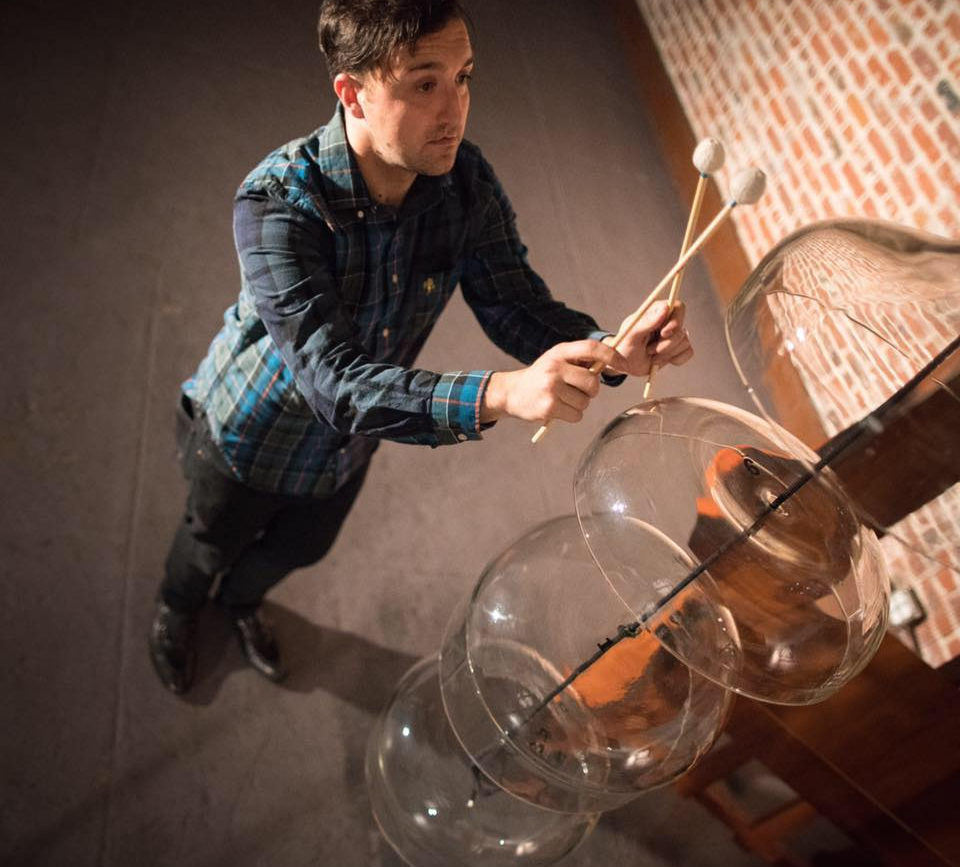
“I was drawn to the unique playing techniques and challenges that Harry’s instruments presented. As a percussionist, I’m always searching for new sounds and new challenges to explore.”
Matt is a highly active member of Los Angeles’ vibrant professional music community: performing regularly on film, television, and other recorded media, he is also a founding member of the illustrious Los Angeles Percussion Quartet (along with another PARTCHian, Nick Terry), as well as a member of the dynamic contemporary music ensemble WildUp. Currently part of the teaching faculty at Fullerton and Ventura Colleges, Matt has recently ventured further in the area of professional Performing Arts administration, working as a Development Director to secure opportunities for various ensembles to continue their mission statement and present their works for public consumption.
“I feel that Partch’s music is most relevant today as a rewarding live concert experience. The albums give listeners a glimpse into his world, but to really experience the music it requires a fully immersive, live concert experience…[It is] the most unique performing experience that I’ve ever been a part of. I think Harry would be proud.”
Each member in PARTCH Ensemble would echo this sentiment in our own way, but Matt’s words are especially prescient, cutting to the core of what our group is about…come see it Live…as this is the most effective, direct, and transcendent communication of thought. Building connections through performance or recordings, through education or development, or through the sheer joy of sharing moments onstage with friends and colleagues…each a branch of the same tree that roots us in the same reality. And while true that music can transcend the spaces between people, it also acts as the very bridge that connects them. We are honored to work alongside Matt Cook for the vast plethora of talent, experience, knowledge, and follow-through of his artistic and professional vision.
Learn more about Matt Cook at his website: www.matthewhcook.com
-
Alison Bjorkedal
“[It] occurs regularly…the instant before we start playing; that breathless silence before the first note, when I crouch down to peer through the kithara and connect with each ‘Partchian’…the excitement, the smiles, the trust in each other…that is my favorite moment.”Musicians are often asked this very simple question: why do you do what you do? Answers vary from person to person, era after era…variations as numerous as grains of sand. And each musician needs to discover their own personal why, and then cultivate that reason into a drive…that’s the point where it is possible to become an artist. It’s a term that is not to be used lightly; those of us in the business of professional music know when we encounter a visionary, a true artist…while it may not necessarily take one to know one, it does take one to understand that the label does not confer a level, or an aptitude. The label is only that.
True artistry is transcendent: it goes beyond talent and embraces the full spectrum of a person and their internal motivations and drives. It’s a lifelong journey, and the joy comes by being a willing and conscious participant in said journey. The journey towards true artistry is similar to that of self-realization: only you can walk the walk.
Composer Harry Partch walked his walk. Many musicians have taken up the walk in the years since Harry’s journey ended in 1974, and have done so with equal parts zeal, love, and madness, with varying results, and of course, a multitude of destinations.
This month’s Member Spotlight features harpist and resident Kitharian Alison Bjorkedal, a stalwart of the Los Angeles classical, new music, and contemporary music community. As with many members of PARTCH, her personal journey into music began at an early age, where the deep end of the pools of music she was shown suffered her no consternation.
“I began playing piano at age 3 and cannot remember a time when music was not a daily, integral part of my life.”
Originally from Kennewick, WA, Alison first encountered the harp in high school, and was able to gain access to an instrument owned by the local school district; from that moment on, Alison’s path was committed to the harp. The path led south from Kennewick, first to the University of Oregon for a Bachelor of Music degree, leading to both Master’s and Doctoral degrees from the University of Southern California. Seeing the musical landscape of Los Angeles as a fruitful bed of opportunity, Alison permanently relocated to southern California, and began quickly making inroads to the broader classical music community.
In 2011, the path veered suddenly towards Harry Partch: “Harry Partch was mentioned, almost as a side note, in an undergraduate music history course. But, sadly, I had not explored his music until…”
Enter John Schneider.
“John speaks with such love about the ensemble and its mission of keeping this music alive…I was delighted by the uniqueness and the incredible wit of the music.”
I will reiterate: it may not take one to know one, but it does take an artist to understand the commitment, the drive necessary to embody the journey of true artistic development, especially as it manifests in another. John recognized it in Alison, and the invitation to join the group was forthcoming, if not altogether expedient.
“…I could not resist his invitation to learn more…”
Alison is PARTCH’s resident master of the Kithara, the 72-stringed behemoth of a harp, setting 12 distinct (thought intrinsically related) hexachords formulating Harry Partch’s unique harmonic foundation. Additionally, Alison has performed extensively on the Harmonic Canons, Surrogate Kithara, Cloud Chamber Bowls, and recently added her voice to the ensemble’s rendition of Harry’s beloved Barstow, performing the part of “Marie Blackwell.”
She serves on the faculty of the California Institute of the Arts, guiding students immersed in their own personal journeys with the harp. Simultaneously, Alison teaches a class in Music Appreciation at Pasadena City College.
“As a teacher, I observe my students’ bravery and commitment to finding their artistic voices and [Harry] Partch’s music mirrors that exploration and expression in a very unique and inspiring way.”
Her career as a first-call harpist has featured performances with Sia, Madonna, Nate Ruess, and Kid Cudi; on-screen appearances with Andrea Bocelli and the Pentatonix; appearances with the San Diego Symphony, Pasadena Symphony/Pops Orchestra, Long Beach Opera, and the Long Beach Symphony.
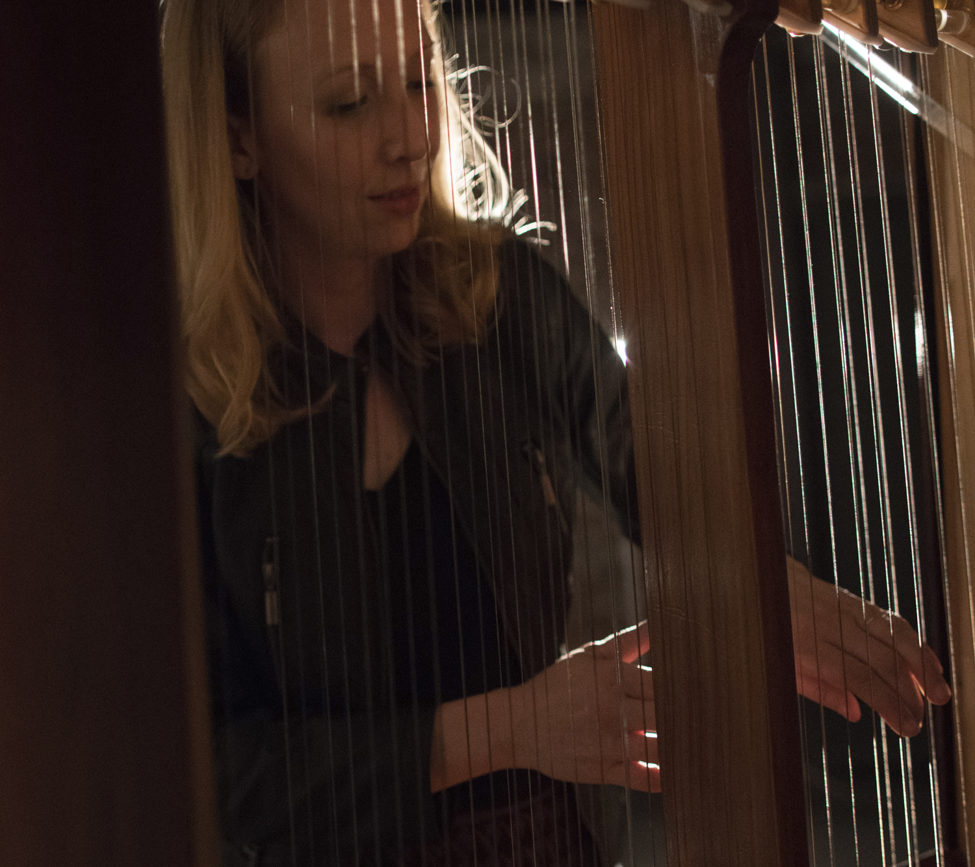
“Discovering Partch’s music has compelled me to think about music differently. It was very humbling to start fresh learning a new type of music notation and an instrument unlike any other…I hope our journey as an ensemble brings that experience to more people as we work to expand our performance and recording opportunities.”
The journey towards true transcendent artistry begins with an unspoken desire; there are years then spent seeking, learning, expanding, before self-actualization…before earning the title “artist.” PARTCH Ensemble is fortunate that each member has not only discovered this journey on their own, but that the path led them to the group. From here on out, it is a shared journey, and for one who has considered the path Less Traveled…knowing that it is shared with friends and mates who share the same values has made all the difference. PARTCH is grateful to be sharing this part of our collective journey with Alison Bjorkedal traveling with us.
Learn more about Alison at alisonbjorkedal.com
-
PARTCHed – May 2019
re-Genesis of a Music
~ A tale of obsession ~by John Schneider
Part V: Adapted Guitar II
By 1998, I had decided that there was no turning back (see Part IV), as the search for a deeper understanding of Partch’s music had already begun in earnest. With the successful construction of the Adapted Guitar I, followed by performances, a recording, and very enthusiastic audience response, I felt absolutely compelled to continue down that path. I wanted more… But what next? Of course! There were at least three different guitars in Partch’s history, and I had only explored one.
Having finally decided that I must reconstruct the 10-string Adapted Guitar II, I was facing all sorts of hurdles. So many questions! It turns out that Genesis of a Music, Partch’s essential book first published in 1949 with a second expanded Edition in 1972, not only serves as an extraordinary music theory primer, hidden history of music, and autobiography— it’s also a cookbook. The ingredients needed to recreate his marvelous instruments can be found in those pages: tantalizing recipes with most of the details intact, though certainly not all, as I was about to find out. Luckily, Partch supplied a photograph for each instrument, and the Adapted Guitar II was no exception.
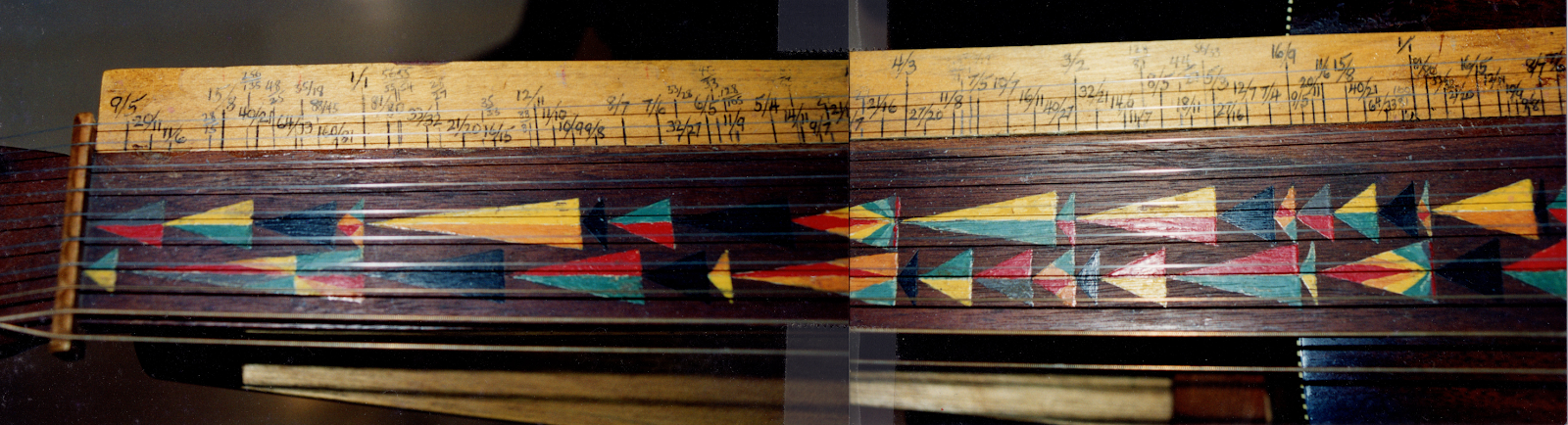
Adapted Guitar II, Genesis of a Music 2nd Edition Sure enough, the exotic fingerboard was there all right, with what was basically a wooden ruler on the treble side that was evidently covered with the ratios of just intonation. But they were completely illegible. AND the fingerboard itself was with covered with an amazing pattern what were supposed to be colored triangles, according to the written description. But it was a black & white photo! Sigh. I would just have to visit the original.
That would have been a lot easier back when I first met the instruments in 1977, when they were still living in San Diego under the supervision of Danlee Mitchell, Partch’s assistant for the last twenty years of his life. But now they were back East and in the care of Dean Drummond & his group Newband, who had been performing and recording with them since their arrival for a spectacular performance of Revelation in the Courthouse Park at Philadelphia’s American Music Theatre Festival in 1987 (recorded on Tomato Records TOM 3004). Sadly, I didn’t have the budget or time to make the necessary pilgrimage east to examine those mysterious colored triangles, but luckily, I happened upon this announcement:
Newband presents “Harry Partch and His Legacy”
Thursday, Sept. 23, 1999 at 8 p.m. at Yerba Buena Center;
Tickets are $13-15. Partch instruments will be on display Sept. 21-23Now that I could manage, Yerba Buena being in San Francisco. So I booked a flight, bought a ticket, and wrote to Dean to arrange some private time with the instruments before the performance.
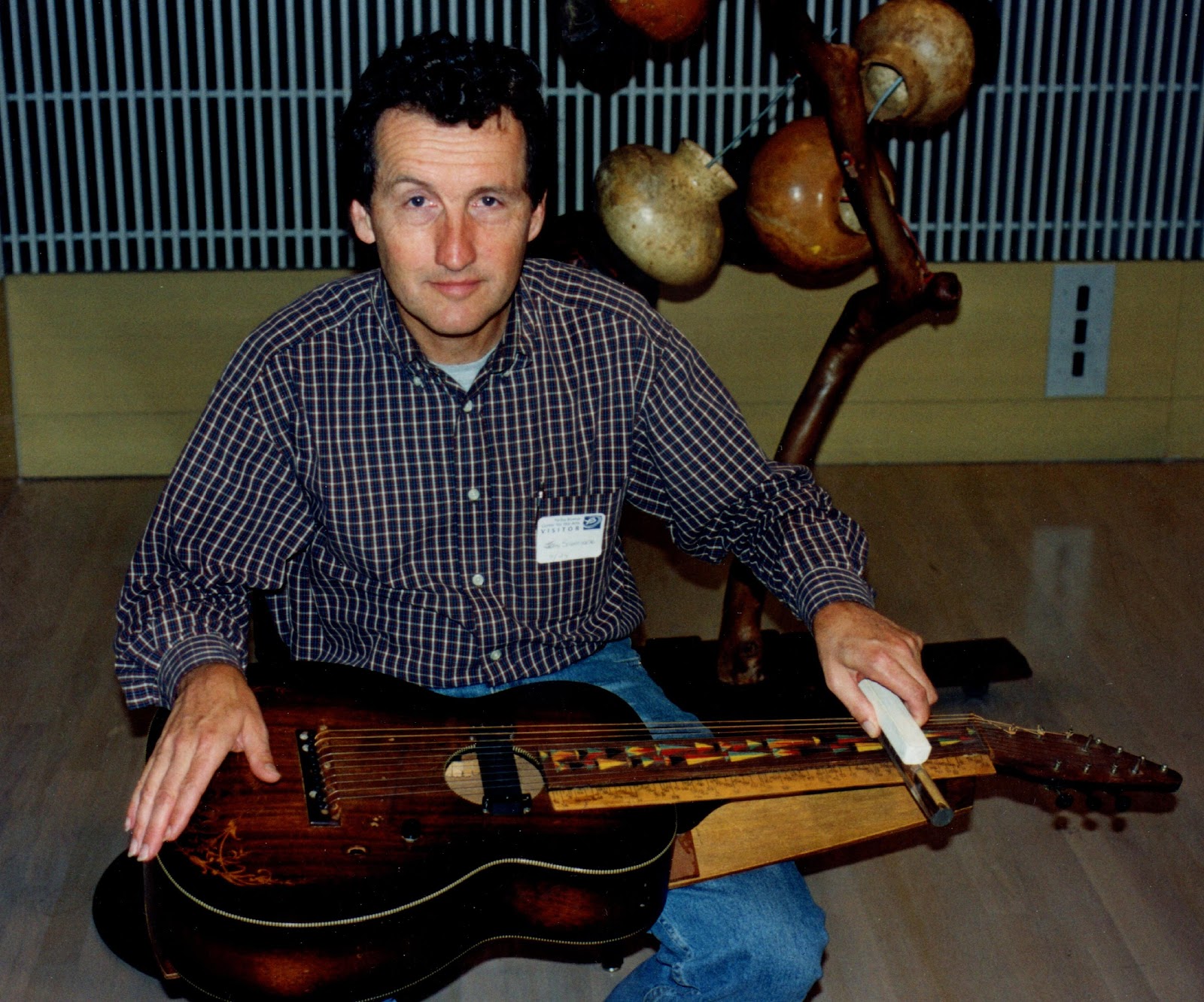
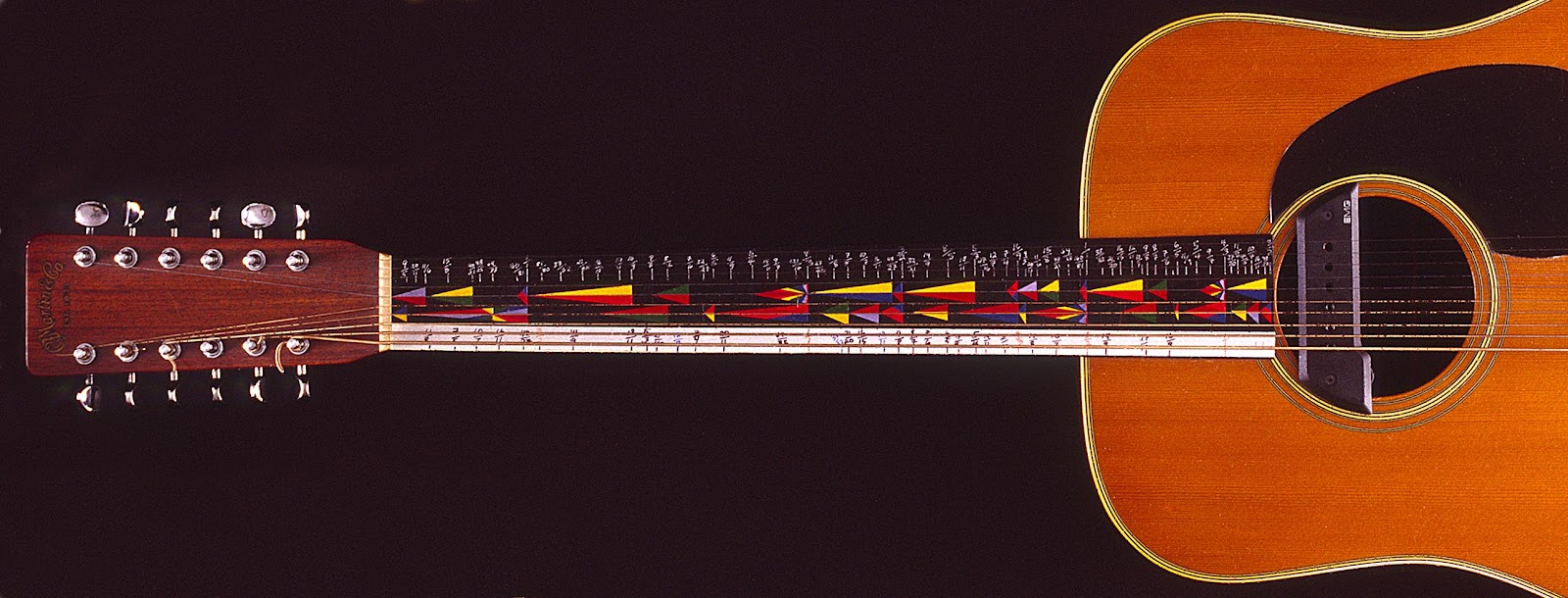
Adapted Guitar II & Gourd Tree My, what a strange instrument this was! Originally a 6-string Oahu brand ‘squareneck’ Hawaiian guitar, this version had ten strings, and the craziest headstock I’d ever seen. When Partch adapts an instrument, it seems like everything changes. In order to add those four extra strings, he attached a set of four connected mandolin tuners to the top of the newly designed tuning head, and made a custom bridge & nut that were much wider than the original, suspending two bass strings & two treble strings over either side of the original fingerboard. And then, there were those triangles:
Adapted Guitar II fingerboard So I took lots of pictures & measurements, bringing them home to figure out what it was all about.
As Partch had discussed in Genesis, the triangles are colored to correspond with the Chromelodeon Color Analogy, assigning the six different colors of the rainbow spectrum to each of the six harmonic overtones of his just intonation Hexads:
1…………..red = root, or fundamental
3…………..orange = 3rd harmonic above the fundamental = perfect 5th
5…………..yellow = 5th harmonic above the fundamental = Major 3rd
7…………..green = 7th harmonic above the fundamental = minor 7th
9…………..blue = 9th harmonic above the fundamental = Major 9th
11…………orange = 11th harmonic above the fundamental = Octave + tritoneRatios would be represented by two colors, since an interval is the relationship between two different pitches. The pure Major 3rd G-B, for example, is described numerically by the ratio 5/4, which is the distance between the 5th harmonic and the 4th. The 4th harmonic is the G two octaves above the fundamental, and would be represented by RED, while the 5th harmonic is the B a major third above that, represented by YELLOW. Thus, to find a 5/4 on a particular string, the guitarist slides the plexiglass rod to the base of a triangle that is colored YELLOW/RED.
Suddenly, it all made sense, as the actual colors were the Rosetta Stone that made the possibility of making an accurate copy the instrument a reality.
But why there were two continuous lines of Isosceles triangles, touching apex to base all the way from the nut to the soundhole? And why were the patterns different? There was only one set of ratios on the ‘ruler,’ which were in the correct order, but they only corresponded to some of the note/triangles in the lower row, not the upper! (Guess I’ll have to ask Partch next time I see him, since Genesis certainly never said why.) What the heck: just copy them, and figure that out later.
Next question: what instrument should I use? I suppose I could try to find a 1930’s Oahu (they were actually manufactured by Kay guitars for the Oahu Publishing Company of Cleveland, Ohio that was riding the huge wave of Hawaiian music’s popularity). Partch’s creative tuning head would be a challenge to make, but not insurmountable. But I remembered the instrument being very hard to handle because of those extra strings hanging over both sides of the neck, the exact place a player hands onto when carrying the guitar on & off stage, let alone removing it from its case. Hmmm…its case…the original had no case, and maybe that’s why! Very impractical.
Ten strings, eh? Wait a minute, there already exist 10-string lap steel guitars that are played in exactly the same way. Perhaps there are acoustic versions? Nope—very rare, so that’s out. 10-string Pedal or Lap steel guitars I could find, but they were all solid body electrics: the sound would be all wrong—another dead end. So instead making a ten-stringer by adding four strings to a six string guitar (6+4=10), I decided to go the other way: get a twelve string guitar, and take two strings off (12-2=10), and that would also fit in a premade guitar case. Hello, Ebay…
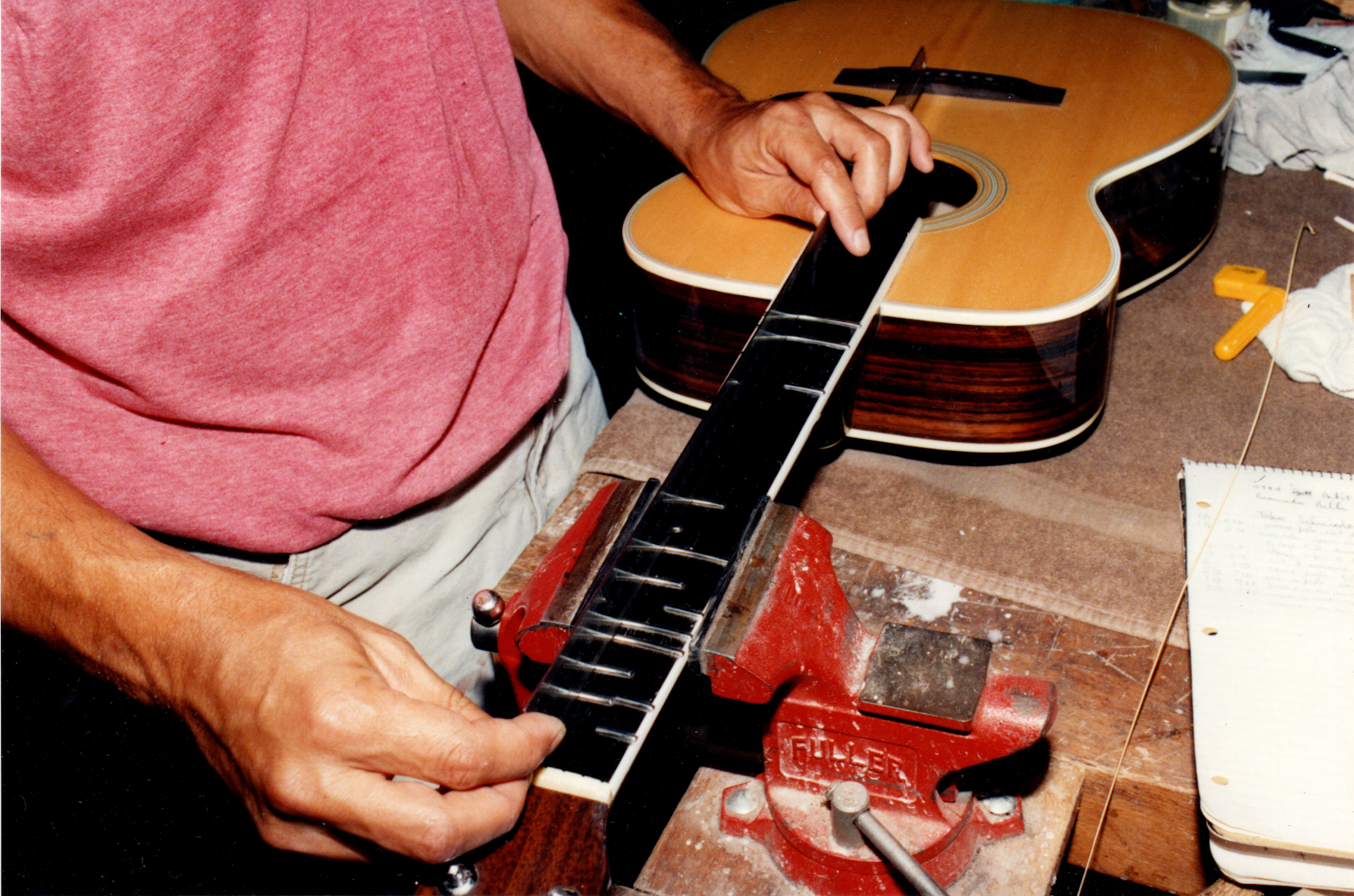
When my 1975 Martin D-12-28 arrived, it went straight to Greg Brandt’s shop, where he removed the frets, and laboriously ground down the Ebony fingerboard to a quarter of its original height, polishing the surface to ready it for the triangles to come. He also copied the original bridge, and replacing the initial six pairs with ten equally spaced holes:
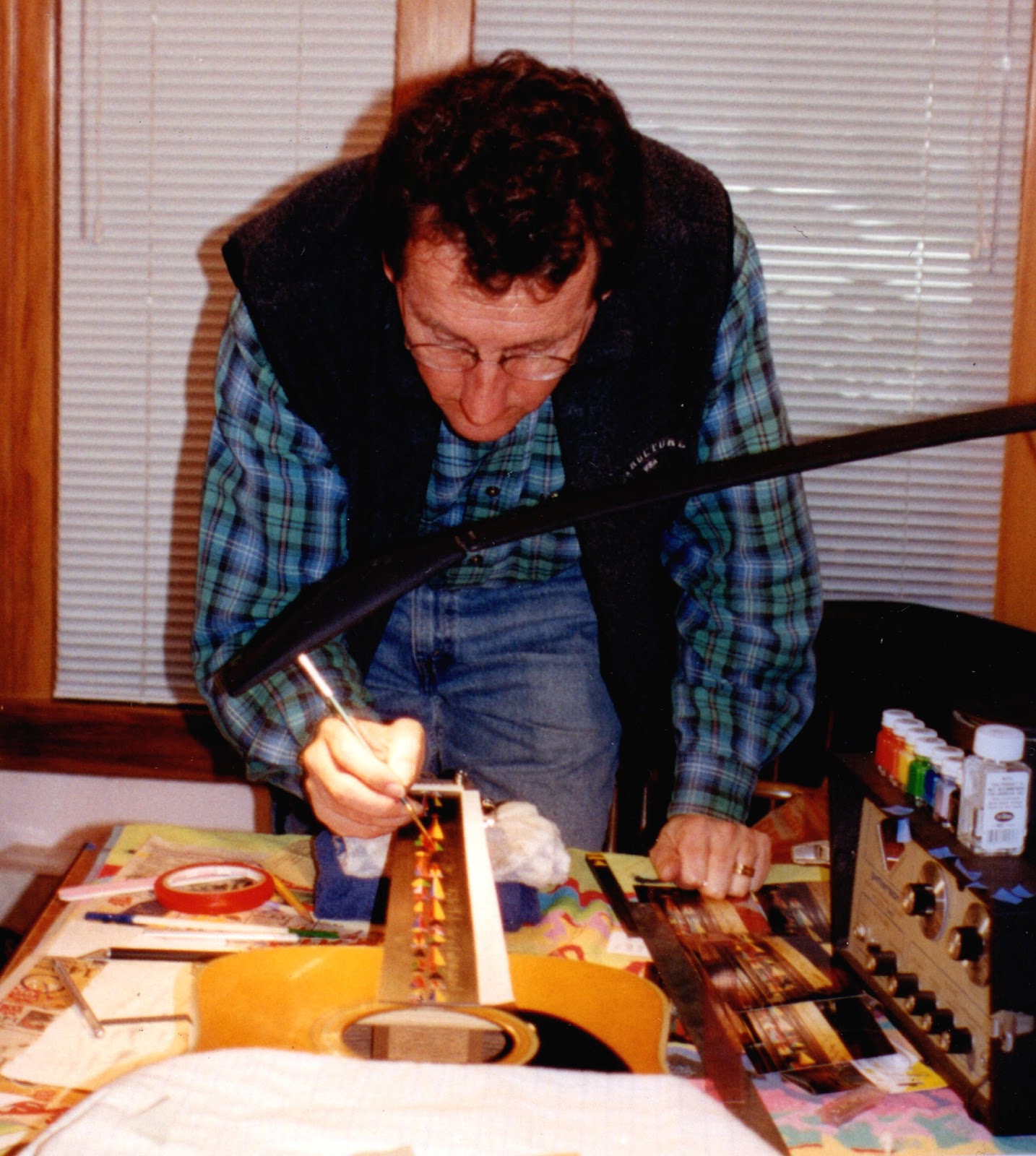
Original 12-string bridge (6 pairs) New 10-string bridge (equidistant) Off to the hobby store to buy six little glass bottles of Testor’s Enamel Paint in red, orange, yellow, green, blue, & violet. Time to paint the triangles! It took almost a month to paint the dozens & dozens of triangles, as each tiny triangle needed a day or so to dry before I could safely use the masking tape to paint those that abutted it.
Painting triangles In the end, there were 142 of them, and as you can see by the patterns, some were monochrome (black = secondary ratios) or two-tone (primary ratios), while some were subdivided into four parts. Several were divided into 14 tiny triangles in 7 separate colors, indicating that the 1/1 G note that it could function as the root, 3rd, 5th, 7th, 9th, or 11th of various different tonalities:
Various Ratios & their Color-coded Triangles on new AGII Mind you, those 142 triangles only described the pitches produced on some of the strings, the lower chain of compound triangles showing the notes for the 3rd, 7th & 9th strings that were all tuned to F (16/9), while it turned out that the upper line revealed the pitch identities found on the 5th, 7th, and 10th strings that were three octaves of C (4/3):
[low ] C – F – C – F – Ab – C – Eb – F – F# – Gb [high]The plexiglass slide would then move to the base of the triangle (the widest part always on the right side from the player’s point-of-view) to produce the wanted pitch:
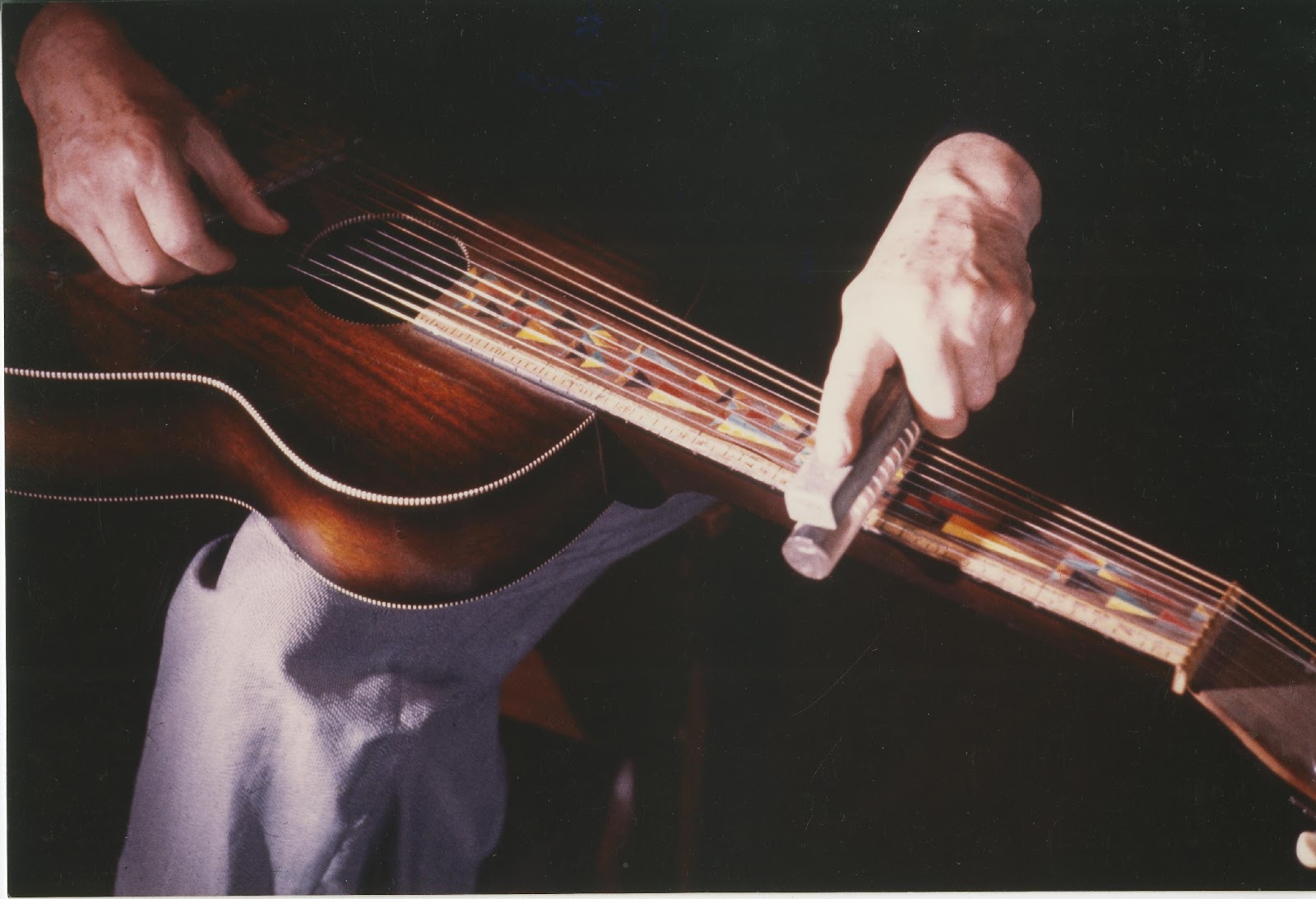
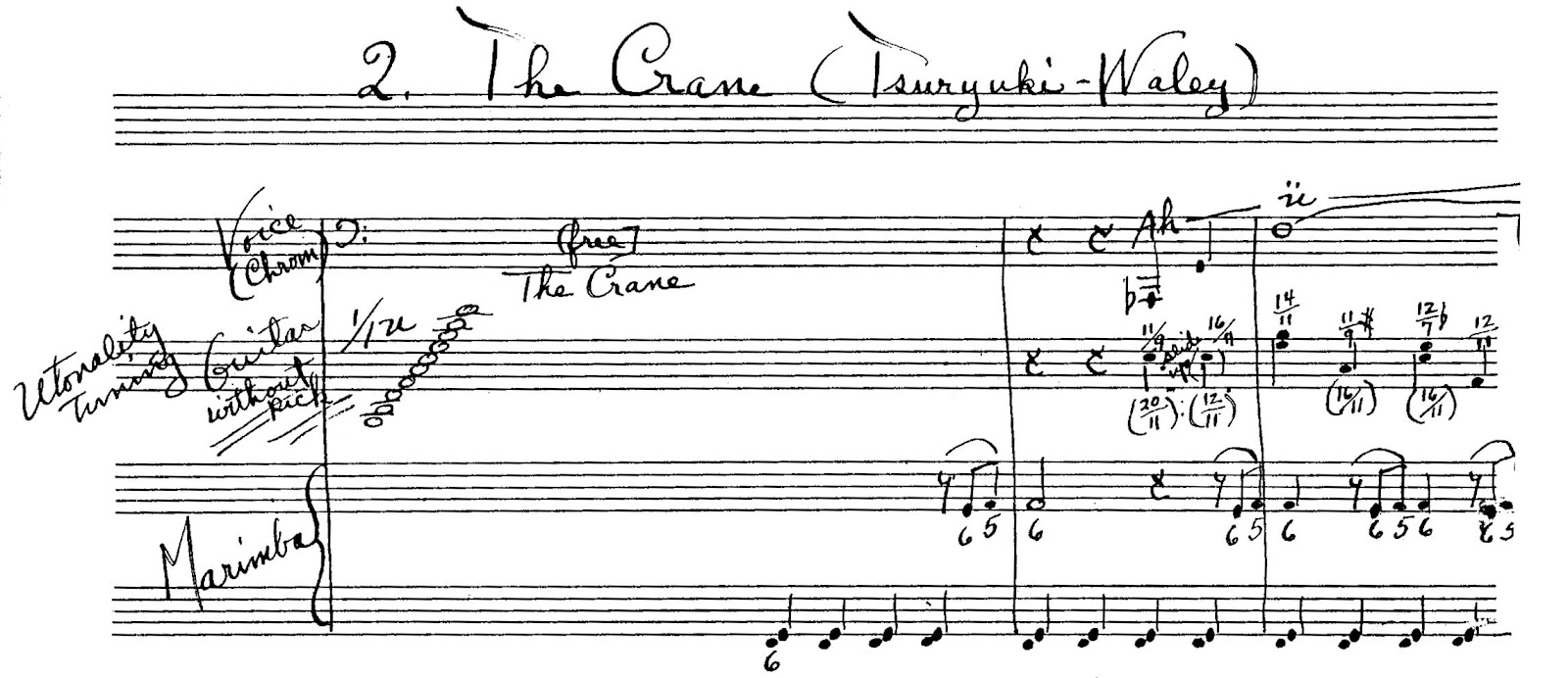
Harry Partch playing his Adapted Guitar II with a lead-weighted plexiglass slide But what if he wanted a note on one of the other four strings? Partch used a kind of tablature that showed which string to play, and where to put the slide using either the top line of triangles or the bottom, depending which tuning he was using. So the ratio in the score tells the performer where to put the slide, not the resultant pitch. In the opening of The Crane (1949), we learn that the guitar is tuned in the ‘minor’ or Utonality tuning that will use the lower row of triangles. The first guitar chord uses all ten strings strummed low to high, and the slide should be placed at the base of the multicolored triangle, indicated by the 1/1 on the white list of ratios on the New Adapted Guitar above:
The opening vocal note, however, was in fact an 11/9 on the 7th string, but the (20/11) below it also refers to where the slide would be if one was using the lower line of triangles. Hmmm. So in making my copy of the instrument, I added another row of ratios on the bass side of the strings to supplement those on the treble side as found on his ‘ratio ruler.’
It must also be remembered that not only did Partch’s Monophonic Scale have 43-tones to the octave, he actually used many more than that. And yet, this Adapted Guitar only has 14 triangles per octave. Why!? Simplicity, really. (He used the same concept on his Adapted Viola, marking only 29 notes out of 43, as we will see in an upcoming edition of PARTCHed.) The triangles are landmarks, but the performer must know where all of the ratios live between them. No small task!
This is, by the way, just one of the reasons that Partch’s music has remained such a mystery for all of these decades. The musicologists, composers, performers and critics that are tacitly responsible for carrying on traditions of the past have had an impossible task when confronted by two dozen unique tablatures for even more exquisitely singular instruments. But fear not—that is starting to change!
After all of the tiny triangles had dried on the new instrument, it was time to figure out what gauge strings to use, since the open strings went as low as the Cello C2 (~65Hz) up to F#4 (~370Hz) which meant a .076” mando-cello string for the lowest note down to a .009” for the highest:
The new Adapted Guitar II (2000) Luckily, Partch himself had recorded the Three Intrusions—“The Crane” as well as two others called “The Rose” & “The Waterfall”—in 1950, so I knew exactly what the instrument should sound like. Tuned up and ready to go, a full year after I had first held Partch’s instrument in San Francisco, I hit that first chord…and it was exactly right:
I was thrilled – those haunting harmonies were finally there beneath my fingers, giving me shivers down my spine. There was only one problem…there was no music for solo Adapted Guitar II! In order to play those Three Intrusions (1949), I would need a marimba. And not just any marimba either, but one shaped like a Diamond…
Stay tuned for Part 6 – “Diamonds are Forever…”
-
PARTCHed – March 2019
re-Genesis of a Music
~ A tale of obsession ~by John Schneider
Part III: “Oh, for a picture—just one picture….!”
Theoretically, I was good to go:
1. I had the score to the solo version of Barstow (1941)
2. I finally knew what actual pitches the dozens of ratios in the music referred to
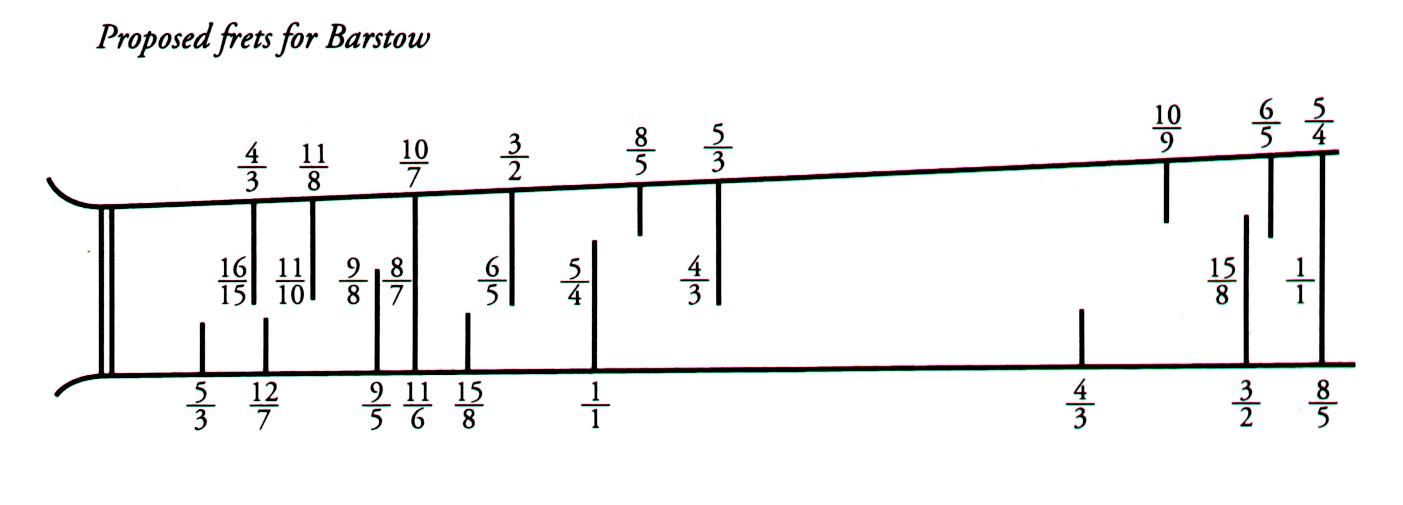
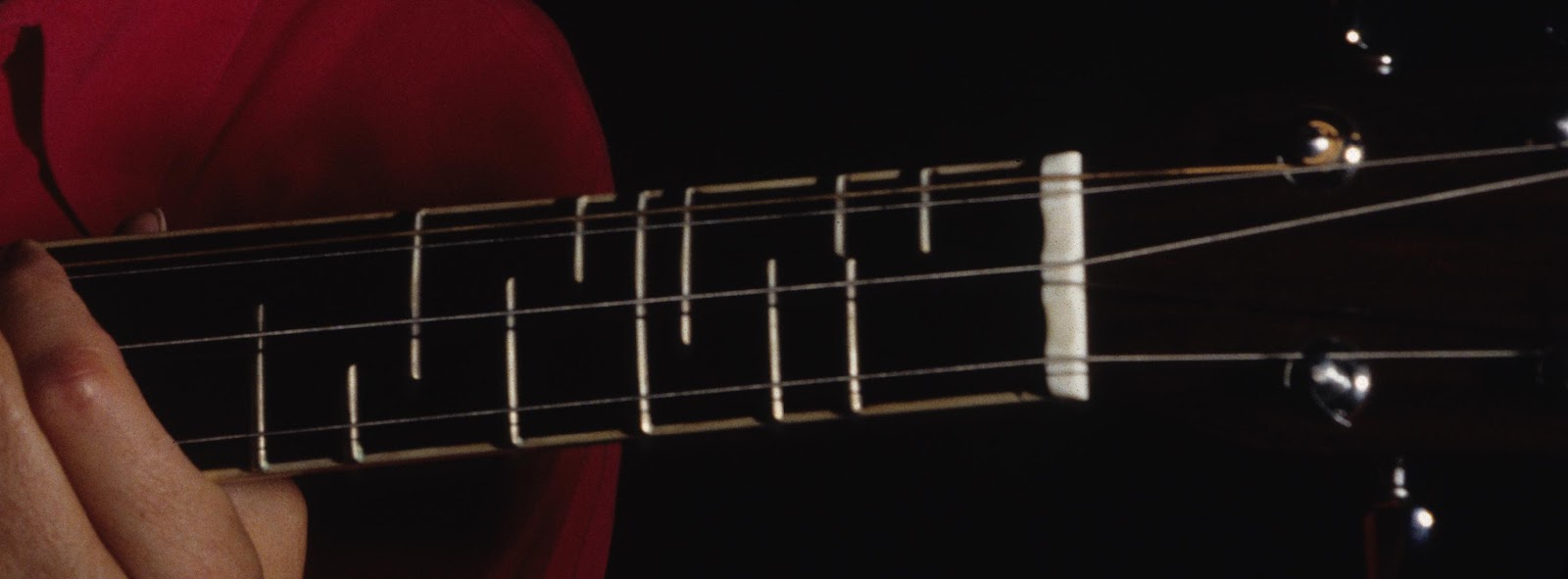
3. I knew how the original Adapted Guitar I was strung and tunedBut most importantly, I had ‘crossed the Rubicon’ and decided that, in order to do the piece justice, I had to recreate not just the notes, but the actual guitar itself. But how far should I go? He couldn’t make standard fretwire work, so he had used “high, stainless-steel frets into slots in a brass plate, which was then screwed onto the neck…” I had access to luthiers who could work with regular frets…perhaps I could reverse engineer the guitar by simply finding which frets I would need to play the piece.
While first attempting to transcribe the piece, I had already gone through the score and determined that Partch had used 39 notes to the octave, but that was for both the voice and the guitar parts. So I wrote out just the guitar notes:
and since the score was written in tablature, I knew exactly which string had to perform each note. Next step? draw a model of the fingerboard:
Looked good…but how would I know if I was right? There was no recording of this earliest version of the piece, and the famous Columbia Recording didn’t even have a guitar in it. If I only had a photograph of the guitar!
Ironically, I knew exactly what kind of guitar it was—a 1927 Koa-wood Martin parlor guitar—as there was a picture of it in his book Genesis of a Music. But years before, Partch had removed the high frets, restrung the instrument with six equidistant G-strings, and turned it into a slide guitar by raising the strings and covering the brass slotted fingerboard with a thin board with painted lines.
There were simply no photos of the original fretting available: I was on my own.
BUT – I remembered that in McGeary’s catalogue, there was mention of some 1945 acetate recordings made by an amateur recordist that included the 1943 version of the Barstow with kithara, guitar, & chromelodeon…so I started making phone calls. Lots of phone calls. This was pre-internet, of course, so research meant letter writing and a huge telephone bill. I was able to track down Dr. Warren Gilson in Wisconsin who had made the recordings, and though he fondly remembered both Partch and the sessions, the details of the instruments were a blur and his records were long gone. I was, however, able to reach Partch scholar Richard Kassel, who kindly mailed me a cassette of Gilson’s recording. I listened to it over and over again, for days on end, to get the sound of Partch’s guitar into my head.
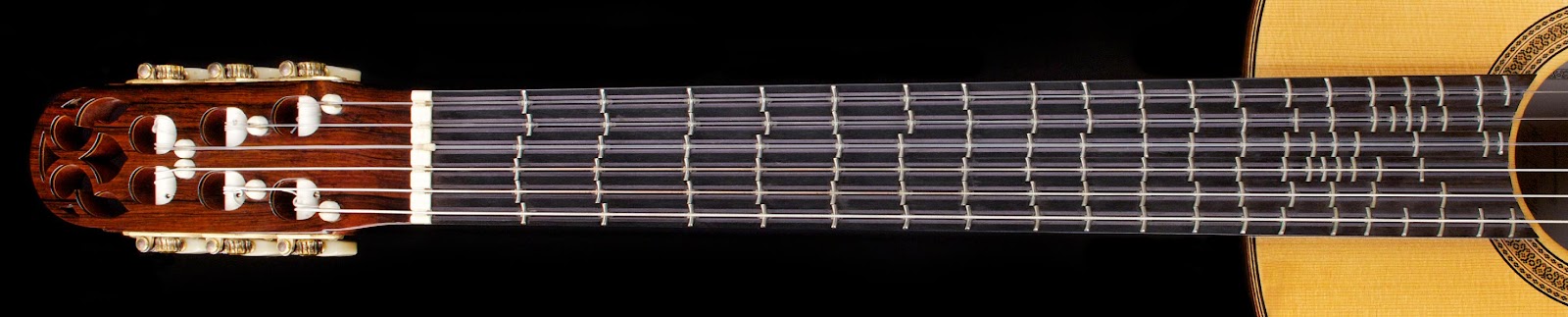
In the meantime, I had acquired a classical guitar that had a special fingerboard invented by the German luthier Walter Vogt that used sliding frets such that each note on every string could be individually tuned.
If I could fret that guitar with the proposed Barstow frets that I had worked out, then I would know if I was on the right track. Since the strings of the Barstow guitar were basically three pitches Eb-G-B (doubled at the octave like a 12-strings), I tuned the 4th string D up to Eb+14¢ [a pure Major 3rd below the 3rd string G], and tuned the 2nd string B down 14¢ to be a pure major third above the G. I then slid the frets to match the pattern I had worked out. Mind you, I didn’t have a proper electronic tuner to tune the frets, but I did have a Yamaha DX7-II synthesizer that I had tuned to the Partch scale, so I carefully matched the frets to the keyboard pitches, sliding one fretlet at a time until they were in sync.
With the tuning and fretting finally done, I gingerly played the opening chords that I had been listening to for weeks. To my amazement, the same strange chords that had been emanating from my stereo were suddenly coming out of the guitar in my lap. It worked! I rapidly went through the score and tried all of the chords, and they all checked out. Time to make some sawdust!
With incredible luck, I had been able to locate a Japanese copy of a pre-war Martin, and took it to the Los Angeles luthier Greg Brandt, who pulled the frets, and prepared the recently vacated premises for its new tenants. He then re-drilled the bridge to place the six strings in three pairs rather than the original equally spaced sextet, and we strung it up. Then, using a piece of fretwire that had the tang ground off, we slid the fret over the smooth ebony surface to mark where each fret should go, using the synthesizer to tune each note by ear.
What a job! First I would find the right note on the synth, then step on the sustain pedal so that the pitch hung in the air while we moved the fret wire up & down until the two notes matched. The slightest move to either the right or left created beats, so the process was very exact. Three hours later, the 27 exact placements had been marked before Greg could make the precision cuts in the wood and start hammering frets:
Three days later, Greg called with the news, “The guitar is ready!” It had taken a professional to accomplish the delicately difficult job of refretting that Partch, a self-proclaimed “philosophic music man seduced into carpentry” was not able to achieve.
And so, in August of 1992, Partch’s original Adapted Guitar was reborn. There in the workshop, I picked up the instrument and began strumming the chords that I had memorized. The paired stringing made the chords very easy to play, and this time, I not only recognized the same chords as the original score, but also the same exact twanging timbres that had been buried in those crackling acetate grooves half a century before.
What a journey! The seeds that had been planted way back in 1978 and the quest that had begun in the Spring of 1991 was over: the music & guitar that I had virtually lived, breathed, slept and eaten for a year and a half was a reality once again. With boundless enthusiasm, I began to rehearse an within six weeks, I was performing the piece in public:
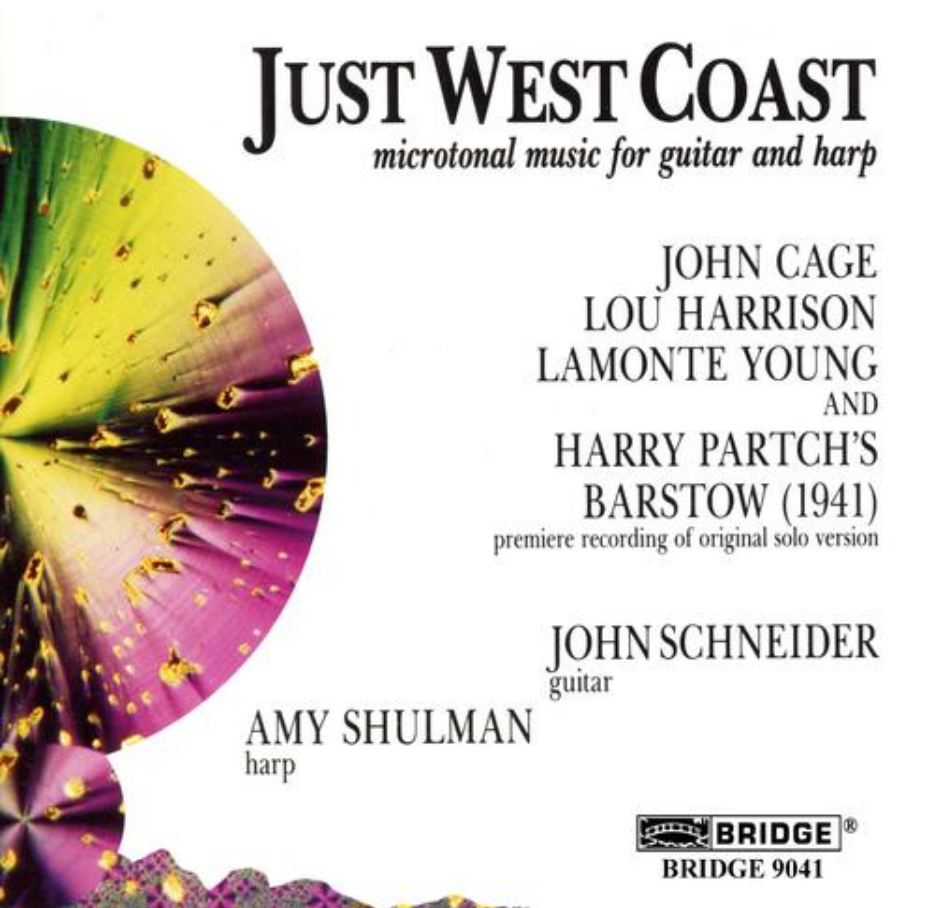
A year later, I had the pleasure of recording the piece for the Bridge Records album Just West Coast, giving listeners a chance to hear the piece as Partch himself had originally conceived and performed it back in the 1941-42:
It turns out that after 1942, Partch started re-orchestrating Barstow, adding new instruments as he invented them: first in 1942, with two voices and Chromelodeon, then in 1943 adding the Kithara, again in 1954 using the slide version of the Adapted guitar with Surrogate Kithara and Diamond Marimba, and finally in 1968 with no guitar whatsoever, but adding his bamboo marimba called the Boo.
But was I right…?
It wasn’t until nine years after I had completed the guitar, having performed Barstow on three continents, that I finally saw a photo of the original guitar with the original stainless steel frets. After all, the music worked – I played and sang every note in the score, but did I get the instrument right? Were my best guesses at the frets and strings correct…?
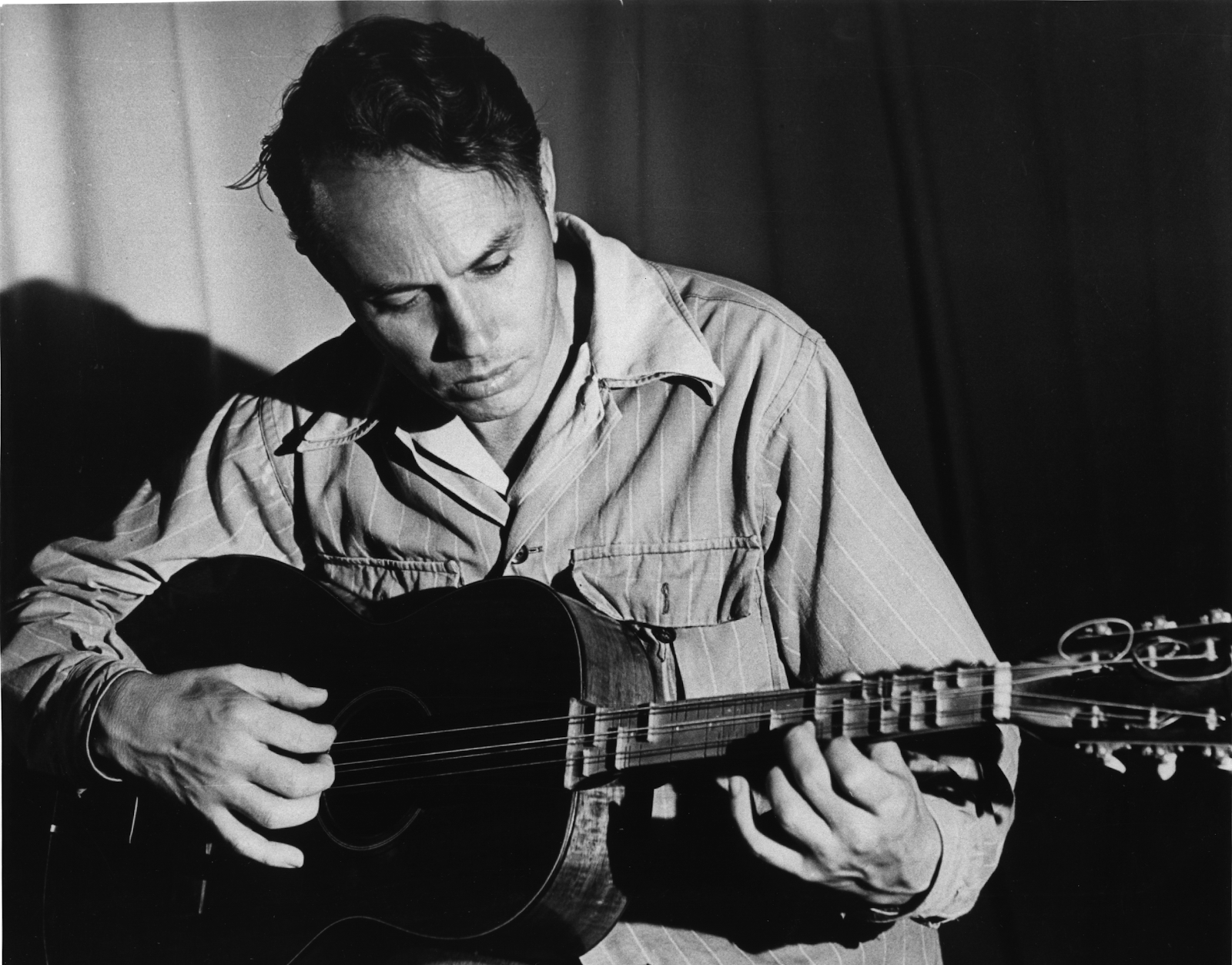
In 2001, I produced a Harry Partch Centennial Celebration at UCLA, a 12- hour extravaganza of lectures, films, panels, and a concert. At the event, the Harry Partch Foundation presented an exhibit of photographs from the composer’s life in the lobby of Schoenberg Hall. And there, amidst dozens of unforgettable prints, to my profound relief and delight, was this photograph:
Turns out that I was right after all. (Whew!!)
Next month: “Wait, weren’t there two Adapted Guitars?”